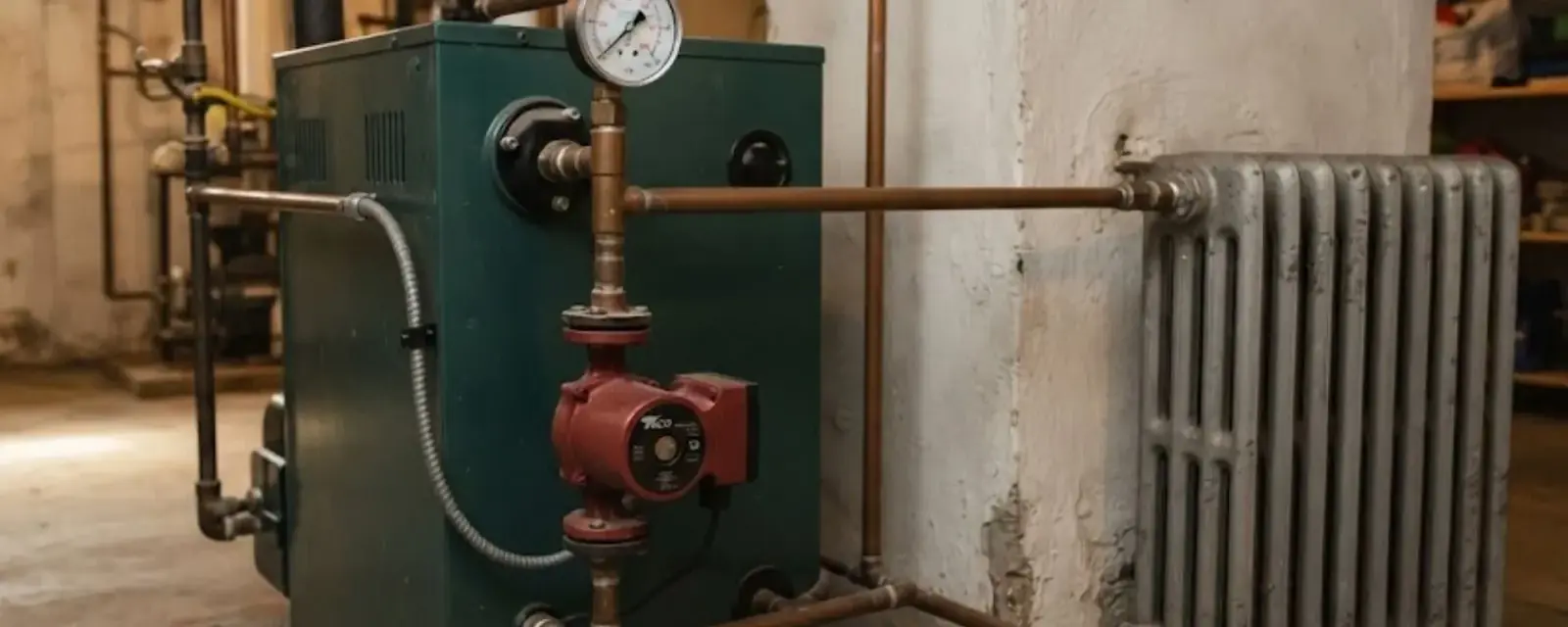
A boiler heats water and sends it through pipes to radiators, baseboards or floor loops. When one fails in Reynoldsburg, OH, the house cools within hours, and a frozen pipe can follow. Our 24/7 emergency dispatch takes boiler calls at any time.
While you wait, check that the thermostat is set to heat, that the boiler has power and that the water pressure gauge is in a normal range. If you smell gas, do not touch switches. Leave first, then call.
Smell gas? Leave the building first
If you smell gas, rotten eggs or hear a hiss near the boiler, get everyone out and call the gas utility or 911 from outside before you call us. Do not flip lights, use a phone inside or try to relight a pilot. We will come after the gas company or the fire department says the building is safe.
When no heat is an emergency
A cold house is a safety issue when temperatures fall, especially with children, older adults or pets inside. Same-day and after-hours visits are how we handle boiler failures in winter, when available hours are the thing that matters. Here is what you can do safely while you wait.
- Confirm the thermostat is on heat and calling for it
- Check the boiler switch and the circuit breaker
- Look at the pressure gauge, but do not add water unless you know how
- Keep taps dripping if pipes are at risk of freezing
- Open interior doors so warm air can spread
- Never run a gas oven or grill to heat the house
What a failing boiler tells you
Boilers give warning before they quit. These signs point to specific parts.
Banging or kettling
Scale or sludge on the heat exchanger overheats water in pockets and makes a rumbling, popping noise.
Pressure falls often
A leak in the loop, a bad expansion tank or a weeping relief valve lets pressure drop and the boiler lock out.
Radiators cold at the top
Trapped air stops hot water from filling the radiator, which a bleed valve may fix.
Boiler cycles on and off
Short cycling can come from an oversized unit, a bad thermostat or a clogged flue.
Pilot or ignition fails
A dirty flame sensor or a worn igniter stops the burner from proving flame and shuts it down.
Puddle under the unit
Water at the base can mean a leaking pump seal, a loose fitting or a cracked heat exchanger.
Heat out and the cold coming in?
A licensed plumber can help you sort the problem and plan a safe fix.
How we diagnose a boiler that will not heat
We work from the safest checks to the deepest.
Confirm safety
We check for gas and combustion issues and a clear vent before touching controls.
Read the controls
Thermostat call, aquastat, limit and error codes show whether the boiler is being told to run.
Check water side
Pressure, expansion tank and circulator pump determine whether heat moves through the loop.
Check fuel side
Igniter, flame sensor and gas valve show whether the burner can start and stay lit.
Repair and test
We replace the failed part, bleed the system if needed and run a full cycle.
Repair or replace the boiler
A sound old boiler can run a long time, but some failures are the end of the line.
Repair is the sensible call when
- The failed part is a pump, sensor, valve or igniter
- The heat exchanger is sound and clean
- Parts are available for the model
- The boiler has not failed repeatedly
Replacement deserves a look when
- The heat exchanger is cracked or leaking
- Parts are no longer made for the unit
- Repairs keep stacking up each winter
- Efficiency is very low and fuel use is high
Pressure, air and the quiet failures
Most boiler calls are not a burned-out boiler. They are a lost-pressure problem, trapped air or a stuck circulator. A closed system should hold steady pressure, and a drop usually means water is escaping from somewhere or the expansion tank has lost its air cushion.
If you top off the system often, call before it becomes a habit. Fresh water brings dissolved air and minerals into the loop, which feed corrosion. The right fix is to find the leak, not to keep adding water.
Symptom, likely cause and next step
A quick guide. We confirm with testing before replacing any part.
| Symptom | Likely cause | What we check |
|---|---|---|
| No heat, boiler silent | Power, thermostat or control fault | Switch, fuse, thermostat call, error code |
| Burner starts then shuts off | Dirty flame sensor or draft problem | Sensor, flue, combustion |
| Hot boiler, cold radiators | Pump failure or air lock | Circulator, bleed valves |
| Loud rumbling or knocking | Scale or low flow | Heat exchanger, flow rate |
| Water leaks at boiler | Relief valve, pump seal or fitting | Valve, seals, connections |
Pairing the symptom with a test avoids replacing parts that were never the problem.
Before you call
A short check saves time and sometimes fixes the problem.
- Confirm the thermostat is set above room temperature
- Check the boiler switch and breaker
- Note the pressure gauge reading
- Write down any lit error code or blinking pattern
- Find out whether the vent outside is clear of snow
- Note any recent noise, leak or smell
What shapes the cost of boiler repair
Boiler work varies more than most repairs, because the boiler type and age change what is possible.
Part involved
A sensor or igniter is a small repair. A pump, gas valve or heat exchanger is a bigger one.Age and model
Older units may need special-order parts and extra time to confirm compatibility.System type
Steam, hot-water radiator and in-floor systems each have their own parts and their own troubleshooting.Cause behind the failure
A repeat failure may need a deeper fix, such as cleaning the system or correcting a pressure issue.After-hours visit
A winter-night callout is work done outside normal hours, and scheduling can affect the visit.Boilers worn out from age are rarely covered, while sudden damage from a burst heating pipe may be. Check your policy and any home warranty you hold.
We give you a clear price before work starts. Want your real number? Call (614) 656-1470.
Licensing and boiler work in Ohio
Ohio licenses plumbing contractors through the Ohio Construction Industry Licensing Board, and its plumbing and hydronics section covers heating water piping. You can check a license through Ohio's online license lookup before anyone works on your system. Ask for it, since hydronic work touches gas, water and venting.
Reynoldsburg sits in Franklin County, where Franklin County Public Health provides plumbing inspection outside Columbus and Grove City. Ask FCPH or your plumber whether a boiler or related piping replacement needs an inspection. For gas utility questions, ask your gas provider.
Questions about boiler repair
Yes. Our dispatch runs 24/7, and a boiler failing in a cold snap is the kind of call that should not wait. Tell us if you smell gas, if anyone is cold or at risk, and what the pressure gauge shows. If you smell gas, leave and call the gas utility or 911 first.
Leave the building at once and call the gas utility or 911 from outside. Do not use switches, flames or phones inside. Do not return until officials say it is safe. After the gas is cleared, we can inspect and repair the boiler.
A leak somewhere in the loop, a faulty relief valve or a failed expansion tank are the common causes. Adding water only masks it. We pressure test the system and look for weeping joints, valves and the tank air charge.
Air trapped in the radiator blocks hot water from filling it. Bleeding the valve can release it. If the air keeps returning, the system may be pulling in air from a leak or have a failing air eliminator.
In Ohio, the plumbing and hydronics section of the Construction Industry Licensing Board covers hydronic work. Check a license through Ohio's online license lookup. For a water heater problem, see our water heater repair page instead.
Yes. Without heat, pipes in outside walls and unheated spaces can freeze in a cold snap. If that happens, see how we handle split pipes and shut off the main if water appears.
Also serving nearby towns
Dispatch for this service runs from Reynoldsburg to the towns below.