
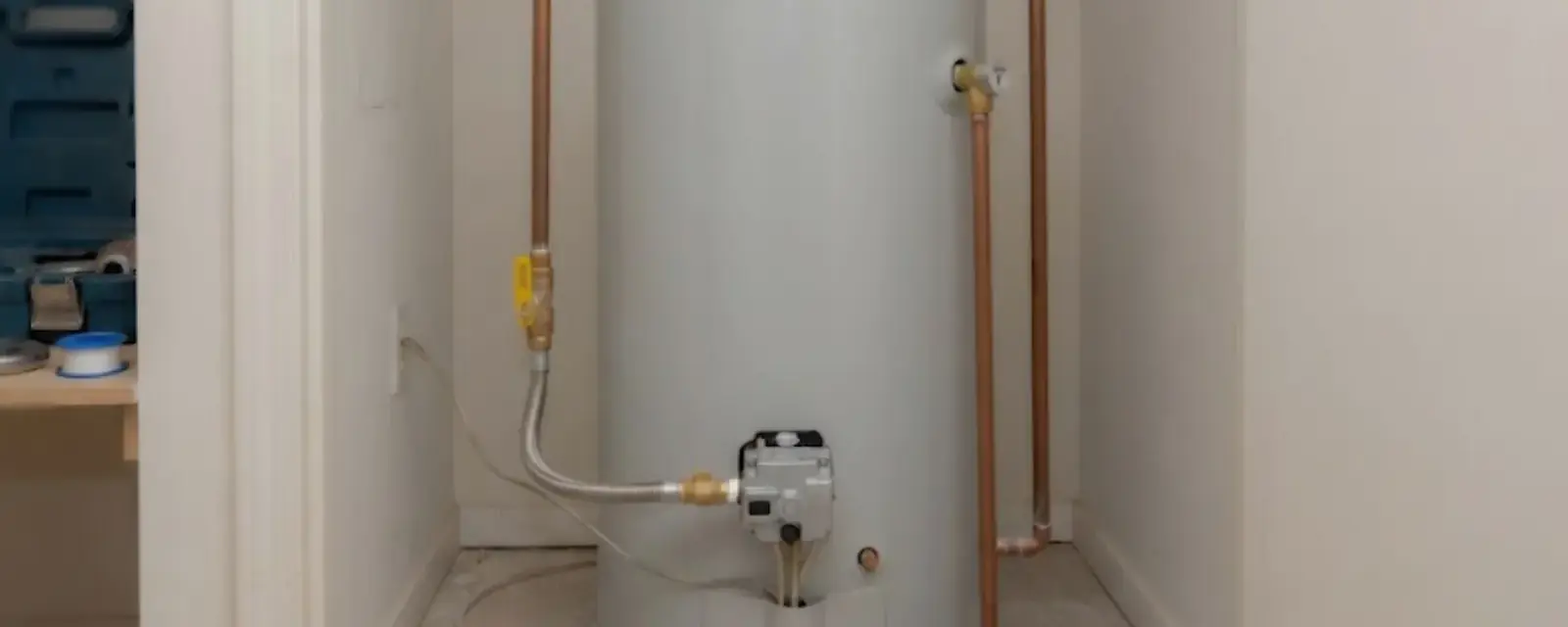
A tank that has failed does not get better, and in Reynoldsburg, OH a leaking heater in a basement can turn into a wet-floor problem fast. Our licensed plumbers answer replacement calls 24/7. Until we arrive, close the cold supply valve at the tank and cut power at the breaker or turn the gas control to off.
Water heater replacement is the removal of a worn-out or failed unit and the installation of a new one on the existing piping, vent, and power or gas supply. The aim is hot water again the same day.
How a tank fails, and why it cannot be patched
Inside a steel tank is a glass-like lining and a sacrificial anode rod that corrodes first to protect the steel. Once the rod is gone, rust works on the tank wall, and a pinhole opens that no clamp or sealant can hold. The water you see on the floor started as a weep that is now a stream.
That is why a leak from the shell is a replacement call, while a leak from a fitting or valve may not be. We open the panel, look at the base, and check the sediment before saying which situation you have.
A flooded heater and what to do first
If water is spreading across a finished floor, the clock matters more than the brand of tank. Call our 24/7 dispatch and describe where the water is, then work through the steps below so the crew finds a calm, dry workspace.
- Close the cold valve on the supply line above the tank
- Flip the water heater breaker off, or set gas to pilot off
- Open one hot tap upstairs to stop the tank from siphoning
- Smell gas? Leave the building and call the gas utility or 911 first
- Sweep water toward a floor drain and lift anything stored on the floor
- Photograph the tank label, since the model and size help us plan
What the replacement visit looks like
A straightforward swap follows this order, though every house adds its own surprises.
Shut and drain
Water, power, and gas go off. The old tank drains to a floor drain or hose line, which can take a while if sediment is thick.
Disconnect
Supply lines, vent, gas flex or wiring, and the relief valve line come apart. Corroded nipples sometimes need replacing here.
Set and level
The new tank goes on a pan or stand as needed, with the controls facing out where they can be reached later.
Reconnect and vent
New flexible connectors go on, the vent is checked for slope and clearances, and a thermal expansion tank is added where the system calls for one.
Fill, fire, test
We purge air, check every joint for weeping, light or energize the unit, and confirm temperature at a faucet.
Waiting on a cold shower?
A licensed plumber can look at the tank today and lay out your options clearly.
Tank, tankless, or heat pump: what the choice changes
Most homes simply replace like for like, but the alternatives affect the house in different ways.
| Type | What it asks of the house | Main tradeoff |
|---|---|---|
| Standard tank, gas | Existing vent and gas line, usually | Lower upfront effort, ongoing standby heat loss |
| Standard tank, electric | A dedicated circuit and room for the tank | Simple, but slower recovery under heavy use |
| Tankless | Larger gas line or high amperage, new vent | Endless supply, more installation work and scale care |
| Heat pump (hybrid) | Airflow, a condensate drain, a 240 volt circuit | Cooler, damper room, slower in cold spaces |
Our tankless water heater page covers the scale and flushing side in more detail.
Switching fuel is a building project, not a swap
Moving from gas to a heat pump heater means a new 240 volt circuit, a condensate path, and space for air to move. It can be a good long-term move. It is also an electrician and plumber job, so ask for it by name instead of expecting it to happen on a standard replacement visit.
No hot water at all, and what it may mean
A heater that has gone completely cold is not always a dead tank. Dead elements, tripped limits, and failed pilot sensors all look the same from the shower. If the unit is more than a decade old and the base is wet or rusty, we recommend replacement. If it is dry inside and the failure is a part, our repair service is the cheaper road.
Columbus water, tank life, and the permit question
Columbus softens water to about 120 ppm, or roughly 7 grains per gallon, and Reynoldsburg is on its list of water contract communities. Even softened water leaves scale on the bottom of a tank and wears an anode over the years. Flush the new tank each year and ask us to check the anode before the warranty paperwork runs out.
Franklin County Public Health inspects plumbing in Reynoldsburg and in Franklin County outside Columbus and Grove City. Whether a permit applies to a water heater swap is something to ask Franklin County Public Health plumbing office or to put to your plumber before work begins, so nothing is left open on a sale or insurance review.
Replace now or limp along
An old tank can seem fine until it is not. These are the factors that tip the decision.
Reasons to replace soon
- Rust streaks or moisture at the base of the tank
- Rumbling, popping, and recovery that keeps slowing
- Tank has gone past a decade of service
- Repairs have started stacking up in a single year
Reasons to hold off
- Leak is at a fitting, not the shell
- Tank is young and sediment is light
- Only an element or thermostat has failed
- You are planning a fuel change and need to line up parts
Information that speeds up your replacement visit
A few facts let us bring the correct unit on the first trip.
- Fuel type: gas, electric, or heat pump
- Tank size in gallons from the label
- Where the heater sits and how tight the space is
- Whether a floor drain is nearby
- How many people use hot water each morning
- Whether the existing vent is metal or plastic
What moves the price of a replacement
A replacement quote is built from the unit and from what the house requires around it.
Unit type and size
A larger tank, a high-efficiency model, or a hybrid each cost more than a standard tank of the same capacity.Vent condition
Old galvanized or rusted flues often have to be replaced when a new burner goes in.Code items nearby
Expansion tanks, new shutoff valves, a pan, and a relief line may be added to bring the setup up to current practice.Access and removal
Stairs, a crawlspace, and old tank hauling all change labor time.After-hours work
Night calls follow a different schedule than a same-day booking.If water from the old tank damaged floors or drywall, a policy may cover the sudden damage but not the heater itself. Your insurer decides, so ask before throwing anything away.
We give a clear price before work starts. Want your real number? Call (614) 656-1470.
Questions about water heater replacement
Yes. Dispatch is open 24/7 for flooded basements and failed tanks. Give the dispatcher your fuel type, the tank size if you can see it, and where the water sits. Same-day appointments are available when the schedule allows, and we stay until the new tank is filled, vented, and tested.
Close the cold supply valve, cut power at the breaker or turn the gas control off, and move stored items out of the water. Leave a nearby floor drain clear. If you smell gas, go outside and call the gas utility or 911. Once the water stops, call us and we can drain the tank safely and set up the replacement.
Usually yes, if you have the right space and electrical capacity. The heat pump needs air movement, a drain for condensate, and a dedicated 240 volt circuit. The gas line gets capped and the old flue comes out. It is a larger project than a same-fuel swap, so tell us up front that you want it.
Life depends on the tank, the anode rod, and the sediment in it. Columbus water is softened to roughly 7 grains per gallon, so scale still collects over time. A yearly flush and an anode check extend service. Without them, tanks usually fail earlier than they should, often at the lower seam.
It depends on how your family uses hot water and on what the house supplies. Tankless needs more gas or power and a different vent. See our tankless guide for the tradeoffs, including flushing for scale, and ask us for a site check before deciding.
If your house has a check valve or pressure reducing valve at the main, heated water has nowhere to expand, and the relief valve may drip. An expansion tank absorbs that pressure. We check for it on every replacement, and planned installation work covers how it is sized and mounted.
Also serving nearby towns
Dispatch for this service runs from Reynoldsburg to the towns below.