
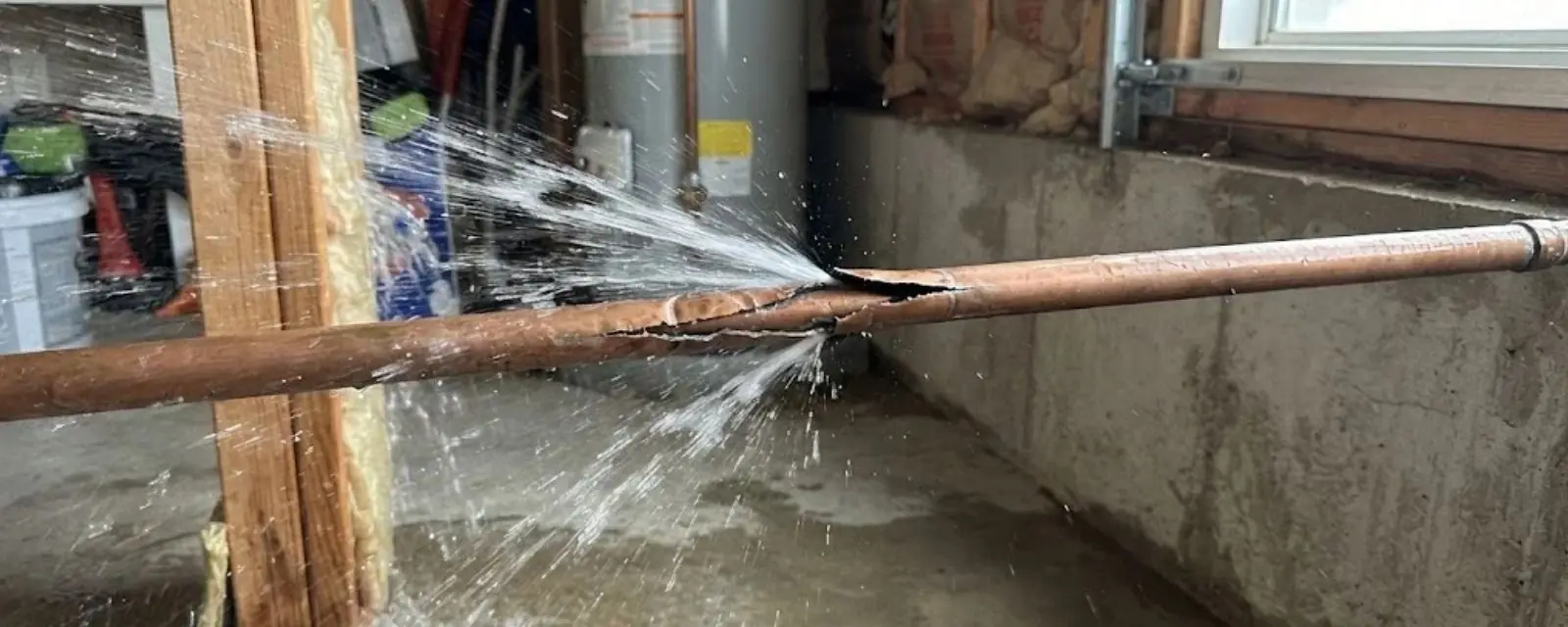
A burst pipe in Reynoldsburg, OH means water is leaving the system faster than any towel can handle. Our 24/7 emergency dispatch takes the call at any hour. While you wait, shut the main valve, open a faucet low in the house to drain the line, and switch off power to any wet area.
Burst pipe repair is the removal of a split, cracked or blown-out section of supply or drain pipe and its replacement with sound material. The work is a cut, a clean fit and a pressure test, then a check that nothing nearby is about to fail the same way.
When a split pipe is an emergency
If water is spraying, pouring through a ceiling or pooling around an electrical panel, treat it as an emergency and act before you dial. A half-inch line at normal house pressure can empty a lot of water into a finished room in under an hour. Same-day and after-hours visits are part of how we run this service.
- Close the main shutoff, usually near the meter or where the line enters
- Open the lowest faucet and the highest one to relieve pressure
- Turn off the breaker for any room where water is dripping
- Move rugs, boxes and electronics out of the wet zone
- Take photos for your insurer before you start cleanup
- Leave the ceiling alone if it is bulging with trapped water
What a cracked or broken pipe looks like
Most pipe failures announce themselves in one of a few ways, and the clue tells us where to cut.
Sudden spray or gush
A fitting blew off or a section split lengthwise. This is the loud, obvious failure, and the shutoff fixes the urgency fast.
Stain spreading overhead
A brown ring that grows hour by hour points to a slow split above the ceiling, often at a joint or a nail strike.
Pressure drops at fixtures
Faucets sputter or run weak because the line has lost its seal somewhere downstream of the main.
Hissing inside a wall
Pressurized water squeezing through a pinhole or hairline crack makes a steady whisper you can hear with the house quiet.
Water meter keeps moving
With every fixture off, a spinning dial means water is going somewhere it should not.
Warped floor or soft drywall
Moisture that has been feeding a failing joint for days leaves cupped boards and drywall that dents under a thumb.
How we repair a cracked pipe
The fix starts with finding the actual break, not just the wet spot. Water runs along framing and pipe, so the stain is often a few feet from the real split. We trace it with a moisture meter, a listening tool and, where needed, small inspection cuts in drywall.
Once the break is located, we cut back to solid pipe on both sides, not just around the visible crack. Brittle or corroded stretches near a failure tend to fail next. The new section goes in with proper fittings, and the line is pressurized and watched before anything gets closed back up.
If the pipe has been failing in several places, we say so plainly. A string of leaks in old galvanized or thin-wall tubing is an argument for replacing the whole run rather than patching one spot at a time.
Water running right now?
Shut the main first, then reach a licensed plumber who answers around the clock.
Repair by pipe material
The fix depends on what is inside the wall. Here is how the common materials in local homes usually get handled.
| Pipe type | Typical failure | Usual repair |
|---|---|---|
| Copper supply | Pinhole from corrosion or a split from freezing | Cut out the section and sweat in new copper with fittings |
| PEX | Crushed fitting or UV damage near a window | Replace the fitting or short section with crimp or expansion connections |
| Galvanized steel | Rust-through at threads, low pressure | Repair a short run or recommend replacement of the line |
| PVC or ABS drain | Cracked bend, failed glue joint | Cut out and glue in new pipe and couplings |
| Cast iron drain | Cracked or rotted bottom of the pipe | Section replacement with no-hub couplings |
| CPVC | Brittle crack at a fitting | Replace the fitting and inspect nearby joints |
Older homes often mix materials, so one visit may involve more than one repair method.
Frozen pipes in an Ohio winter
Water expands as it turns to ice, and the pressure builds between the ice plug and the closed faucet, not in the ice itself. That is why pipes split at one spot, often a few inches from where the freeze sits. Lines in exterior walls, crawl spaces, garages and unheated basements go first when the temperature falls and stays down.
If a pipe is frozen but not yet burst, keep the faucet open, warm the area gently with a hair dryer or space heater placed safely, and never use a torch. Once the ice melts, a split reveals itself as a sudden leak. Shut the main right away and call. A pipe that froze once is worth wrapping or rerouting afterward.
Copper pipe repair and drain pipe repair
Copper fails in predictable ways. It pinholes where water chemistry or flow has thinned the wall, and it splits when frozen. We repair by cutting out the bad stretch and soldering in a fresh length, or by using push-fit and press fittings where flame is unsafe near framing. Each method has tradeoffs in cost of materials and speed.
Drain pipes break differently. A cracked drain does not spray, it seeps, and the sign is a damp spot, a smell or a slow drain. For a cracked trap arm, a split in a stack or a collapsed stretch below a slab, we cut out the damaged piece and rejoin it. If the problem sits underground and long, sewer line options come into play.
Patch the spot or replace the run
Not every burst pipe deserves the same answer. We weigh a few things before recommending one.
A spot repair fits when
- The pipe around the break is clean and solid
- This is the first failure on that run
- Access is easy and the cut is short
- The cause was a one-time event like a freeze
A longer replacement fits when
- There have been repeated pinholes in the same line
- The pipe is rusted or scaled inside
- Pressure was already poor before the break
- Several joints show green or white crust
A small leak is still a leak
Not every pipe failure is a gusher. A weeping joint, a seeping elbow or a pinhole under a sink wastes water for weeks and soaks framing quietly. We handle these as ordinary leak repair and usually fix them in one visit.
If you cannot tell where the water is coming from, start with finding the hidden source before cutting anything open. A repair done at the wrong spot is a repair done twice.
What to check before you call
A few quick checks help us bring the right parts and pick the right approach.
- Find and close the main shutoff, then test whether it holds
- Note which fixtures lost water or pressure
- Check the water meter dial with everything off
- Look for a wet ceiling or a damp wall nearby
- Photograph the damage and the shutoff locations
- Know whether the pipe is copper, plastic or steel
What drives the price of a burst pipe repair
No two breaks cost the same, because the work behind the wall changes the job.
Access to the pipe
A break under an open basement joist is quick. One behind finished drywall or a tile shower wall needs opening and patching.Pipe material and size
Copper, PEX and cast iron use different parts and different labor. Larger lines take more material and care.How much needs replacing
A short cut-out is cheap in time. A long run with repeated corrosion adds pipe, fittings and hours.After-hours dispatch
A night or weekend call is real work done outside normal hours, and that can change how the visit is scheduled.Water cleanup
Drying, drywall and flooring repair are separate trades. We stop the water and fix the line, and say where other help is needed.Coverage for a burst pipe often depends on whether the damage was sudden or gradual, and on your policy language. Ask your insurer before you start repairs on the damaged materials, and keep your photos.
We give you a clear price before work starts. Want your real number? Call (614) 656-1470.
Burst pipes in Reynoldsburg homes
Reynoldsburg, in Franklin County, buys its water from Columbus, which lists the city as a water and sewer contract community. Ask your water utility which section of the line is theirs. The line from the street to your shutoff is not always the same owner as the pipe inside, and that decides who to call first.
If a break is outside, near the driveway or along the yard, the repair may involve digging. Ohio law requires whoever digs to notify OHIO811 at 811 before breaking ground, at least 2 working days ahead. The contractor makes that call, but you should know the timing before you plan the repair.
Questions about burst pipe repair
Yes. Dispatch runs 24/7, and after-hours calls get the same plan as daytime ones. We stop the water, find the break, and make a repair that holds or a safe temporary fix if parts are not available at that hour. Tell us on the phone if you have shut the main, and if any water is near outlets or the electrical panel.
Close the main shutoff, then open the lowest faucet to drain remaining water from the line. Turn off the breaker for any wet room. If the ceiling is bulging with trapped water, poke a small hole into a bucket so it can drain in a controlled way. Then call and take photos for your insurer.
Yes. Ice can plug a split and hold water back, so the leak starts only once the ice melts. That is why a frozen pipe that looks fine should still be checked when the weather warms. Keep the shutoff nearby, and watch for dripping or a damp spot over the next few hours.
A failed fitting leaks at a joint, often with white or green crust around it. A cracked pipe leaks along the pipe wall or at a bend. Both can look similar from outside the wall, so we open the smallest access we can and check the actual joint or pipe before cutting.
A temporary clamp or push-on fitting can slow a leak while you wait. It is not a lasting repair, since the pipe around the damage is often weak. Soldering near framing is a fire risk, and a bad joint inside a wall can fail later. Call a licensed plumber for the actual repair.
Yes, for the private portion. Where the utility owns the line, we tell you who to contact. See our page on underground water line repair for how that work goes, including the OHIO811 call.
No. It can also be a roof leak, condensation on an AC line or a failed shower pan above. A moisture check and a look at the meter help separate those. We trace the source before we cut into any finished ceiling.
Also serving nearby towns
Dispatch for this service runs from Reynoldsburg to the towns below.