
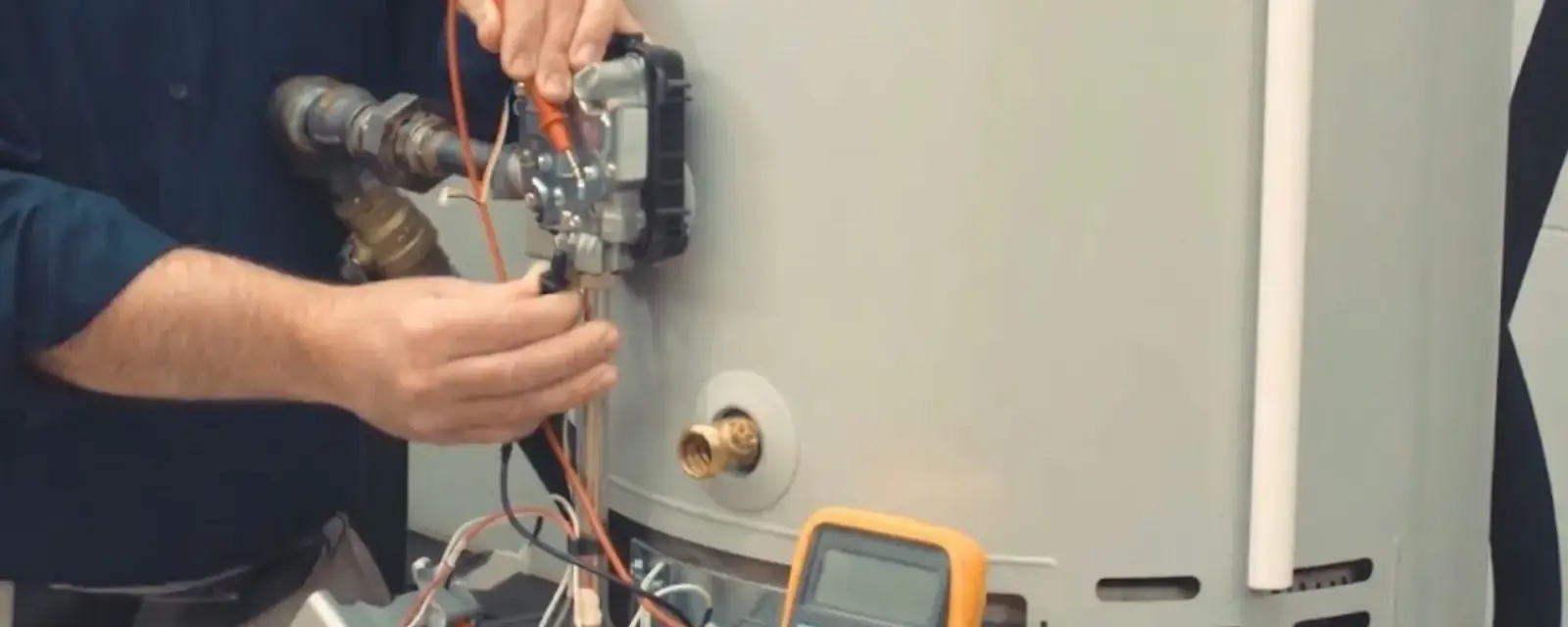
A water heater that leaks or goes cold needs a quick decision, so licensed plumbers take water heater repair calls in Reynoldsburg, OH around the clock through 24/7 emergency dispatch. While you wait, shut the cold water valve above the tank and switch off the power at the breaker or turn the gas control to off.
Water heater repair means finding the single failed part, such as an element, thermostat, burner assembly, valve, or fitting, and replacing it so the tank keeps working. When the tank shell itself is leaking, repair stops being the right word.
When a leaking water heater is an emergency
Water running from the tank body or pooling under it can ruin a finished basement floor in an afternoon. The dispatcher will ask where the water is and whether the heater is gas or electric so the plumber arrives with the right parts.
- Close the cold supply valve on the pipe above the heater
- Turn the breaker off for an electric unit before touching anything
- Set a gas control to off, but only if it is dry and easy to reach
- If you smell gas, leave the building and call the gas utility or 911 before calling us
- Run a hose from the drain valve only if the floor drain is clear
- Move boxes, paint cans, and electronics off the wet floor
Water heater leak: where the water is really coming from
Location tells us whether a fitting fix will do or the tank is finished.
Top connections
Dripping at the hot and cold nipples is often a loose or corroded fitting. Dry them, and if the drip returns, a repair usually fixes it.
Relief valve line
Water from the discharge pipe means pressure or temperature is exceeding the valve rating. A failing valve is one cause, and high water pressure or a missing expansion tank is another.
Drain valve
A slow drip at the lower valve happens when sediment keeps the seat from closing. Replacing it is a short job.
Tank body or base
Water oozing from the jacket or the bottom pan means the inner steel has rusted through. That tank cannot be patched.
Condensation
Cold tanks sweat in humid weather, and some gas models drip from the flue. The test is whether the dripping stops when nobody uses hot water.
Leaks at the garage edge or on a slab
Many heaters sit in a garage, a utility closet, or a slab-level corner. A small leak there slides under the tank and creeps along the concrete to the edge, where it shows up as a wet strip or a stain on a wall that has no pipes. That looks like a slab leak but often is not.
To tell the difference, shut the cold valve at the heater and check whether the wet area stops growing. If it does, the heater or its fittings are the source. If it keeps spreading, the water is coming from somewhere else, and our leak detection work uses acoustic and pressure testing to follow it.
Heater leaking right now?
Shut the cold valve and call, because the dispatch line is staffed all night.
Electric and gas: what usually fails
The failure list is short for each type, which is why most repairs are quick when the tank itself is sound.
Electric tank
- Upper or lower heating element burns out or shorts
- Thermostat or high-limit reset trips and stays tripped
- Breaker or wiring at the unit shows heat damage
- Wet insulation under the access panel from a slow leak
Gas tank
- Thermocouple or flame sensor fails and the pilot will not hold
- Gas control valve stops opening the burner
- Burner ports clog with rust flakes or lint
- Flue draft problems cause soot or a lazy flame
Hybrid heat pump water heaters
A hybrid unit adds a compressor and fan on top of a tank with backup elements. Its repairs include condensate drain clogs, dirty air filters, fan faults, and sensor errors, along with all the usual element and thermostat problems. They also need room to breathe, so a closet with no airflow can cause a shutdown that looks like a failure.
We check the display first. Most hybrids store an error history that narrows the search before a panel comes off.
No hot water: the order we test
With no hot water at all, we start at the power or fuel. An electric unit gets a breaker check and a voltage test at the terminals. A gas unit gets a look at the pilot or igniter and the vent. If energy is arriving, the next suspects are the thermostat, element, or sensor, in that order.
Lukewarm water is a different story. A dip tube that has cracked sends cold water straight to the outlet, and a burned-out lower element leaves you with half a tank of hot water that runs out quickly.
Repair or replace: how the findings point
A part swap is worth it when the tank is healthy and the failure is isolated.
| What we find | Repair makes sense if | Replacement makes sense if |
|---|---|---|
| Dead element or thermostat | Tank is clean inside with no seepage | Tank is old and heavily scaled |
| Leaking T&P or drain valve | Fitting threads are intact | Water also weeps from the base |
| Pilot or igniter trouble | Burner chamber is free of rust | Burner box is rotted or flame rolls out |
| Water from the tank jacket | Never, a tank shell cannot be fixed | Always, see full tank replacement |
| Rumbling and slow recovery | A flush brings recovery back | Sediment is rock hard and has coated the elements |
Columbus water and what it leaves in your tank
Columbus softens its water to an average of 120 parts per million, about 7 grains per gallon, and Reynoldsburg is listed among its water contract communities. That is not zero hardness. Minerals still settle on the bottom of a tank and bake onto electric elements, so a heater that has never been drained is a common repair call here.
Drain a few gallons from the lower valve into a bucket once a year. If the water runs gritty or cloudy, sediment is building, and an annual flush costs less than the element it protects. Ask us or Franklin County Public Health whether any permit applies when the repair grows into a replacement.
Quick checks before you phone
These take five minutes and sometimes solve the problem outright.
- Reset the breaker once and see if the unit hums
- Look for a tripped reset button behind the upper panel
- Confirm the gas valve handle sits parallel to the pipe
- Feel the discharge pipe and check for drips
- Note any blinking light pattern or error code on the controller
- Check whether hot water is gone at every faucet
What changes the price of a water heater repair
The same cold shower can be a fifteen minute part swap or a failed tank, so the price tracks these items.
Which part failed
A thermostat is a small part. A gas control valve or a compressor in a hybrid unit is a bigger one.Tank age and condition
Putting a new part in a tank on its last legs can waste the visit, so we show you the inside condition first.Fuel type and venting
Gas work includes flue and combustion checks that add steps.Access and location
A heater in a tight attic or behind a wall takes longer to reach than one in an open basement.Water damage cleanup
Draining, drying out the pan, and fixing a failed pan drain are separate from the heater repair.Coverage often turns on whether the leak was sudden or gradual and what your policy says about appliance failure. Your insurer can answer that before you file anything.
The price is stated before the first part is ordered. Want your real number? Call (614) 656-1470.
Questions about water heater repair
Yes. Dispatch is 24/7 for leaking tanks, burst fittings, and gas or electric heaters that have tripped out. Tell the dispatcher the fuel type, the tank size if you can read the label, and where the water is. Same-day appointments are offered when available for problems that can safely wait a few hours.
Bottom leaks have three main sources. A loose drain valve is the easy one. Condensation drips on cold days are harmless. The serious one is a rusted-through tank, where the steel has failed and the water comes from the shell. If the pan stays wet after you dry it and the valves look dry, plan on replacement.
Electric heaters usually have a dead element, a tripped high-limit button, or a thermostat fault. Gas heaters most often lose the pilot or the sensor that proves the flame. A sudden loss of heat after a power cut or a blown breaker is worth resetting once. If it fails again, stop and call, because repeated resets can hide a short.
A yearly drain of a few gallons is a reasonable habit in our area, given Columbus water at about 7 grains per gallon. Turn off power or gas, connect a hose to the lower valve, and let it run to a safe drain. If the valve will not close afterward, call us. Old valves often fail when they are opened after years of neglect.
Codes vary by maker. Typical ones flag a failed temperature sensor, a flame failure, a tripped limit, or a clogged condensate line on hybrids. Write down the code and the blink count before you power-cycle the unit. We can read the history and match it to the unit before ordering parts.
If the leak is at a fitting or valve and the tank is otherwise sound, repair is cheaper in every case. If water is coming through the shell, or the tank shows rust flakes and heavy sediment, replacement is the safer route. Our notes on planned installation explain what is involved once you decide.
Often yes, but it involves venting, gas line sizing, and sometimes a new electrical circuit. The comparison in our tankless water heater guide lays out the tradeoffs, including scale in a heat exchanger with local water.
Also serving nearby towns
Dispatch for this service runs from Reynoldsburg to the towns below.