Sewer line repair means fixing the pipe that carries wastewater from your house to the public main, whether by replacing a section, relining the pipe, or repairing a joint. Homeowners in Reynoldsburg, OH call when sewage backs up into a basement drain, the tub gurgles, or a yard dips over the line.
A sewage backup is a health hazard and our emergency dispatch runs all night too. Until we arrive, stop all water use, keep everyone off the wet floor, and do not run a washer or dishwasher.
When sewage is coming up through a drain
Sewage in a basement is not just a mess. It carries bacteria, and it keeps coming as long as water goes down the drains upstairs. The first goal is to stop adding water and get the line draining so the house is usable again.
- Stop all water use, including toilets, showers and the washer
- Keep children, pets and bare feet away from affected floors
- Turn off power to any basement outlets only if the floor is dry
- Wear rubber boots and gloves for any cleanup before we arrive
- Tell us which drain overflowed first, since that points to the blockage location
Reading a sewer backup
Where the backup shows up tells a lot. If only one tub or sink is slow, it is likely a branch line. If the lowest drain in the house, often a basement floor drain, bubbles or overflows when upstairs fixtures run, the main line is restricted.
A main line can be blocked by roots, grease, a collapsed section or a bellied stretch where water pools and solids settle. Clearing it gets the house working. If the cause is pipe damage, the blockage will return until the pipe is fixed, which is why we camera before deciding.
How we diagnose before we dig
Repair choices depend on what the pipe looks like, so we look first.
Run the camera
We record the pipe from the cleanout toward the street, noting cracks, offsets, roots and low spots.
Locate the problem
A locator on the camera head shows depth and position above ground, so the dig or lining plan is accurate.
Decide who owns it
If trouble sits at or beyond the property line, the city or utility may own that piece.
Present the options
You see the footage and the choices: spot repair, lining or replacement, with the tradeoffs spelled out.
Sewer smell or repeat backups?
Describe what the drains are doing and we will plan the camera and repair visit.
Open trench digging versus trenchless lining
Pipe lining and pipe replacement solve different problems. This is how they differ in practice.
Open trench replacement
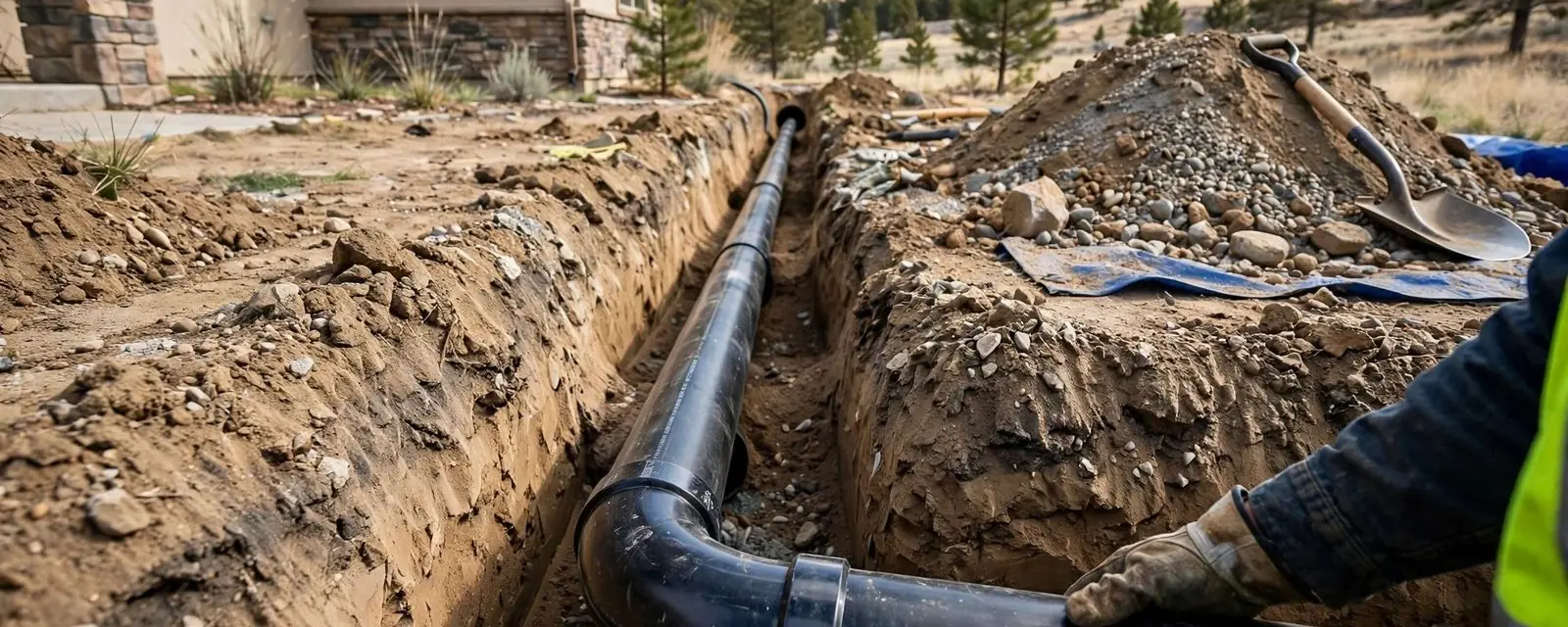
- Removes the old pipe entirely and installs new pipe
- Fixes bellies and offsets by regrading the line
- Disturbs lawn, driveway or landscaping along the route
- Needs an OHIO811 call before any digging starts
Trenchless lining
- Cures a new resin pipe inside the old one
- Leaves yard and driveway largely untouched
- Does not fix a belly or a fully collapsed section
- Reduces pipe diameter slightly, which rarely matters
Pipe lining and trenchless repair
In lining, a resin-soaked tube is pulled or inverted into the cleaned pipe and cured in place, creating a smooth new pipe wall that seals cracks and root entry points. It works best when the old pipe still holds its shape and has no belly. Joint offsets and crushed sections usually rule it out.
The pipe must be cleaned first, often with a jetter, so the liner bonds. We also check that any connecting branch lines can be reopened after curing. If the camera shows the pipe is too deformed, we will say so instead of selling lining that cannot work.
Cast iron sewer pipe problems
Older homes often have cast iron drain pipe near the house. Cast iron rusts from the inside, building scale that narrows the pipe, and eventually the bottom of the pipe wears through, leaving a trough in the soil. Signs include slow drains, repeated clogs, sewer smell and rust flakes on the camera.
Repair options depend on how much of the pipe is sound. A short failed section can be cut out and replaced with PVC using no-hub couplings. If the whole run is scaled and thin, lining or replacement makes more sense than patching, since a new patch next to a weak pipe invites the next failure.
Matching damage to the likely fix
A starting point before the camera footage confirms the plan.
| What the camera shows | Typical repair | Main tradeoff |
|---|---|---|
| Roots at one joint | Cut roots, spot repair or liner | Roots return if the joint stays open |
| Cracked but straight pipe | Trenchless lining | Pipe diameter shrinks slightly |
| Belly holding water | Dig and regrade section | More yard disturbance |
| Collapsed or crushed pipe | Open trench replacement | Needs excavation and utility marking |
| Scaled, thin cast iron | Lining or full replacement | Patching tends to fail beside weak pipe |
Sewer drain and main line cleaning as part of repair
Sewer drain cleaning and main sewer cleaning open a blocked line, and they come before nearly every repair. If your main has roots or grease but no damage, regular cleaning may be all you need. The sewer line cleaning page explains how often and with what tools.
A cleaning without a camera is a guess about what you still have. If backups are returning, ask for a camera inspection of the line and see the footage yourself.
Sewer and septic questions
Septic service belongs to a separate system with a tank and drain field. Not every property is on a public sewer, so confirm with your city or your water and sewer bill which one you have. If your house sends wastewater to a tank, the tank, baffles and distribution box get serviced differently than a city lateral.
We focus on the sewer line between house and tank or main. For tank pumping and field work, ask whether the tank is the problem before spending on the line.
Sewer ownership, inspection and digging in Reynoldsburg
Reynoldsburg is a Columbus sewer contract community, which means a backup can start on your private line or on a public main, and the line that is yours usually ends before the street. Find out where the public main begins before you assume the whole pipe is on you.
Franklin County Public Health provides plumbing inspection for Reynoldsburg, and you can ask them, or your plumber, whether a sewer repair needs a permit and inspection. Digging brings an OHIO811 notice with at least 2 working days, placed by whoever does the work.
Check before you call about a backup
A few things to look at so we can plan the right equipment.
- Which drains are slow, gurgling or overflowing first
- Whether neighbors on the street have the same problem
- How recently the line was cleaned or snaked
- Whether the cleanout cap is visible and accessible
- Whether big trees or shrubs sit near the line
- Any yard dips, sinkholes or wet patches over the route
What changes the price of a sewer repair
The price is stated before work begins, and it turns on these.
Repair method
A spot repair, liner and full replacement carry different labor, equipment and restoration needs.Length and depth
A short, shallow section is quick. A deep line under a driveway adds digging and surface work.Pipe condition
Roots, scale and offsets change whether lining is possible and how many passes cleaning needs.Surface restoration
Concrete, landscaping and pavers affect how much work follows the pipe.Hour of the call
An overnight emergency call carries different pricing than a daytime booking.Many policies treat sewage backup as an add-on rather than standard coverage, and sudden versus gradual damage matters. Call your insurer before cleanup starts.
Want a figure for your own pipe? Call (614) 656-1470.
Questions about sewer line repair
Yes. A backup after midnight gets the same first step: open the line so the house can drain. We do the camera work and repair plan once it is flowing, and we tell you plainly if the damage needs a scheduled dig.
A clog clears and stays clear. Damage keeps coming back. Repeat backups within weeks, sewer smell, yard dips and a camera showing cracks or a belly all point to damage. The camera footage settles it.
No. Roots at a single joint or a cracked straight pipe often fit a spot repair or lining. Full lateral replacement is for collapsed, badly bellied or scaled lines. We show the footage so you decide based on what the pipe looks like.
Lining is a good fit for cracks and root entry when the pipe is round and flows downhill. It is a poor fit for belly sections and crushed pipe. We confirm with the camera before recommending it.
Generally the homeowner owns the private line to the connection with the public main. Where that connection sits varies. Call the city or the sewer utility, and we can mark the camera location to help.
A line that is restricted but flowing may wait with careful use. A line that backs up repeatedly should not. Water in the soil from a cracked pipe can also undermine ground over time. Ask us after a camera pass.
Also serving nearby towns
Dispatch for this service runs from Reynoldsburg to the towns below.