
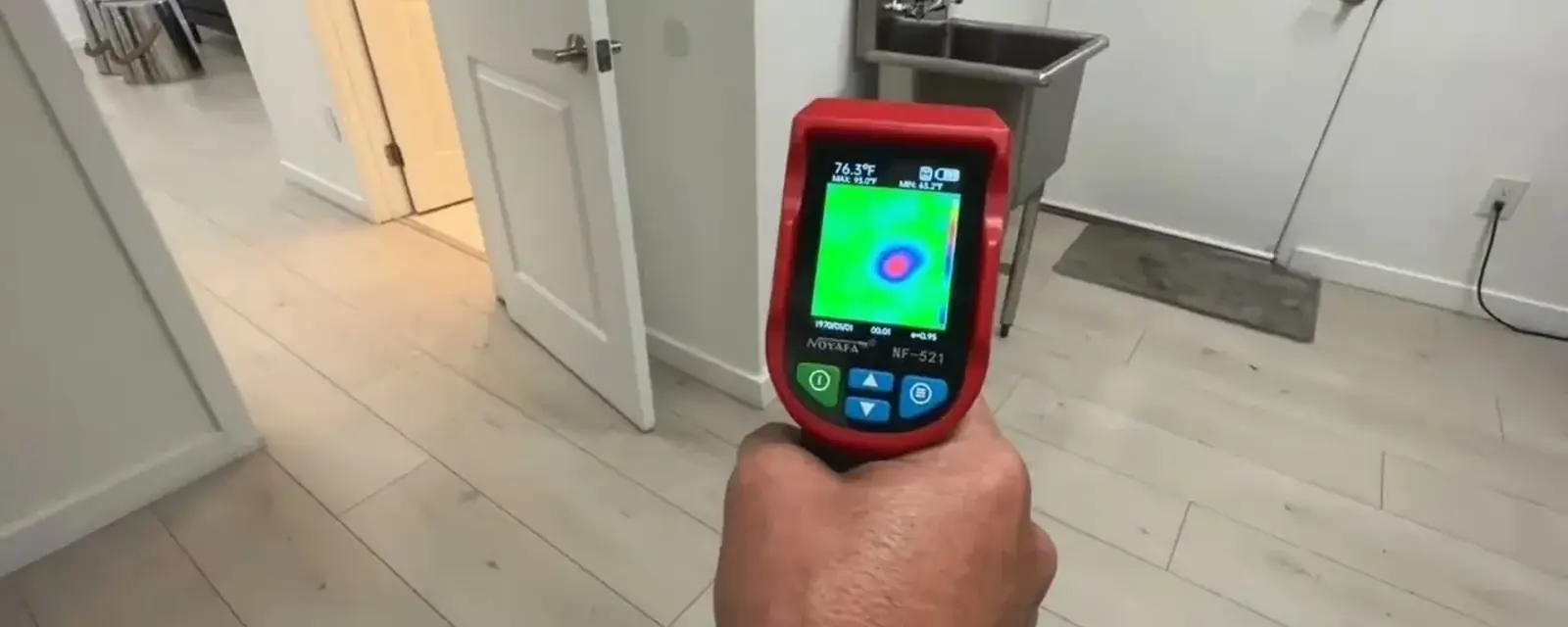
Leak detection is the work of locating a water loss you cannot see, using meter readings, pressure tests, acoustic listening and thermal imaging, so repairs open the smallest possible spot. Homes in Reynoldsburg, OH get this call for high bills, stained ceilings and floors that feel damp for no reason.
Active water loss is urgent even when it is slow. Our 24/7 emergency dispatch covers it, and if a pipe is spraying, close the main shutoff first and then call.
The bill jumped, the wall is stained, and nothing is dripping
Most hidden leaks announce themselves sideways. The water bill creeps up for two cycles. A baseboard swells. The basement smells like wet cardboard on a dry week. A faucet is not dripping anywhere, so people assume it is the weather or a different problem.
The technical name for the work that sorts this out is leak detection. It is a process of elimination: prove there is a leak, decide which part of the system it is in, then narrow it down to a few feet. That order saves you from a hole in the wrong wall.
Check the meter and your high bill first
A water meter is the cheapest leak detector you own. This takes ten minutes and nothing but a flashlight.
Stop all water
Shut off taps, the ice maker and the washer. Make sure no one flushes or runs the softener regeneration.
Read the meter
Open the lid and look for the small triangle or dial that spins at low flow. If it moves with everything off, water is leaving somewhere.
Write the numbers
Note the register digits, wait an hour with nothing running, and read again. Any change is a loss, and the size of it hints at the leak size.
Split the house
Close the main shutoff inside the house. If the meter still moves, the leak is between the meter and your house. If it stops, the loss is inside.
Test the toilets
A few drops of food coloring in each tank, no flushing for fifteen minutes. Color in the bowl means a flapper is leaking.
Meter moving with everything off?
Tell us what the meter test showed and we will plan detection around it.
Why a quiet leak raises the water bill
A pinhole at normal pressure can pass a few gallons an hour. That is under a dribble, so you see nothing, but over a billing period it adds up to thousands of gallons. A running toilet flapper does the same thing and is the most common culprit we see.
If the meter test shows steady loss, ask your water utility how your meter is read and how bills are estimated. A bill that jumps after an estimated reading is a different problem than a real leak, and the meter test tells you which one you have.
Ceiling and wall leaks
A brown ring on a ceiling usually sits below the real source, because water follows framing and pipe sleeves before it drips. We start with the room above: a tub overflow, a failed supply connector, a shower pan or a drain joint. Wall stains behind a vanity or a washer box often trace to a supply line crimp or a loose fitting.
Thermal imaging and a moisture meter show the wet area without cutting. We then pressure test the suspect line to confirm. The aim is one small access hole, sized to the pipe, not a rolled-up section of drywall.
Signs of a hidden leak before the stain shows
These clues point to water you cannot see.
- Bill rises with no change in how many people live there
- Water meter dial moves when every fixture is off
- Hissing or trickling sound inside a quiet wall
- Paint bubbling or wallpaper seams lifting at one spot
- Musty smell that returns after you air out the room
- Floor boards cupping or vinyl seams separating
- Warm spot on a floor over a hot water line
Under-house and crawlspace leaks
In a crawlspace you can see what a slab hides. Supply lines hang from joists, drain lines sag between hangers, and a small drip leaves a dark trail on subfloor wood or a patch of damp insulation. Look for rusted hangers, mold on the underside of the floor, and a chronic smell.
We separate supply from drain: a supply leak drips under pressure all day, while a drain leak only runs when someone uses a fixture. That one test tells us which line to isolate. Wear gloves and a respirator down there, and stay out if you see standing water near wiring.
Where the leak is and how we locate it
Different spots call for different gear, so we match the tool to the suspected location.
| Suspected area | First tool | What it tells us |
|---|---|---|
| Inside a wall or ceiling | Moisture meter and thermal camera | Edges of the wet zone |
| Pressurized supply pipe | Pressure gauge on isolated line | Which loop is losing pressure |
| Under a slab | Acoustic ground microphone | Loudest point of escaping water |
| Buried service line | Meter test, then listening | Whether loss is before the house |
| Drain pipe | Dye, camera or flood test | Cracked section or loose joint |
Tracer gas is sometimes used where sound is hard to separate from traffic or machinery.
Buried water line leaks outside the house
The service line runs from the meter to the house underground. A leak there may show as a soggy patch in a dry lawn, a sinkhole, low pressure, or a meter that spins with the house shut off. The meter split test above separates it from interior problems.
We listen along the route with an acoustic microphone, because water escaping a pressurized pipe makes a distinct hiss in the soil. Digging is the last step. In Ohio the person digging calls OHIO811 first, and that is a minimum of 2 working days before the shovel, so plan the repair around it. Our water line repair work picks up where detection stops.
Slab leaks under the floor
A slab leak is a leak in a pipe running under or inside a concrete floor, common on homes built on a slab and with copper lines in the concrete. Signs: a warm or hot spot on the floor, the sound of running water at night, carpet damp from the underside, or a bill that rises with no visible source.
We confirm with a pressure test and then pinpoint with the acoustic microphone. Your options are repairing at the leak point by opening the slab, rerouting the line through walls or attic, or repiping. Rerouting avoids breaking concrete but opens walls. We explain the tradeoffs and our whole-house repipe work when the pipe itself is the problem.
When a water leak cannot wait until morning
If water is running onto a floor, through a ceiling, or around electrical outlets, treat it as an emergency. Call us for 24/7 dispatch, and do these things while we are on the way.
- Close the main water valve at the meter or heater
- Turn off breakers for any wet room if you can reach them dry
- Open a low faucet to drain the pressure out of the lines
- Move furniture and electronics away from the wet area
- Photograph the damage for your records and insurer
Leak you can chase yourself versus leak to call in
Some water problems are a ten minute fix. Others need gear and a licensed hand.
Reasonable to try yourself
- Dye test for a running toilet tank
- Tightening a loose supply connector by hand
- Reading the meter with all water off
- Checking visible pipes under sinks with a dry tissue
Time to stop and call
- Meter moves and you cannot see any drip
- Warm floor, hissing wall, or sagging ceiling
- Water near panels, outlets or ceiling light fixtures
- Any digging near a buried line or utility
Irrigation, pool and yard leaks
Irrigation: a zone that stays wet, a valve that ticks, or a lawn patch that is greener than the rest points to a lateral line or a stuck valve. Shut the system off and watch the meter. If it stops, the leak is in the sprinkler loop.
Pool and spa: water level that drops faster than normal evaporation can mean a plumbing leak in the return lines. A bucket test, with the bucket on a step and water levels marked inside and outside, separates evaporation from a loss. We cover the plumbing lines but not pool liners or equipment.
Yard and meter box: a meter box full of water, or a wet ring around the curb stop, can mean a leak at the meter couplings. That part may belong to the utility, so ask your water utility who owns it before anyone digs. In Reynoldsburg, Blacklick Creek can keep ground damp after rain, so a wet yard alone is not proof. A meter that runs with the house off is.
Leaks, bills and wet ground in Reynoldsburg
Your bill and your meter come from the same utility, which makes that office the first call about a high reading. Ask your water utility how often your meter is read and whether the reading was estimated, then compare it with your own meter test above.
Blacklick Creek runs through the city, and low areas near it stay wet after storms. That makes ground-surface clues unreliable, so we rely on meter and acoustic evidence before anyone digs. For a leak at a faucet or valve, our faucet and valve repair can fix the visible source.
What drives the cost of finding a leak
You hear the price first. These factors change how long detection takes.
How hidden it is
An exposed supply line takes minutes. A line under a slab takes listening gear and patient work.Number of tests
Isolating zones, pressure testing and moisture mapping each add time, but narrow the opening.Access to the area
Finished basements, tight crawlspaces and attics slow the work.Repair that follows
Locating is one job. Repairing the pipe, patching drywall and restoring floors are separate.Hour of the call
Night calls and daytime appointments are priced separately.Insurers tend to separate a sudden burst from slow seepage. Many pay for the water damage but not the pipe, so read your policy and phone your insurer before repairs, and keep your photos.
Curious what your own leak would take? Call (614) 656-1470.
Questions about leak detection
Yes, any hour. If water is actively coming through a ceiling or floor, shut the main valve and call. We stop the flow first, then schedule the full detection and repair work, because finding a slow hidden leak goes better in daylight with a dry house.
Turn off all water, open the meter lid and look for the small low-flow indicator. If it spins or the register changes after an hour, you have a loss. Close the main inside the house to see whether the loss is outside or inside the building.
Usually a faint hiss or trickle at night when the house is quiet, sometimes with a warm patch on the floor. Hot line leaks are easier to feel. A meter test and an acoustic microphone confirm the location without cutting the concrete.
Often yes. Moisture mapping, thermal imaging and pressure tests show where the water is. We open one access hole at the confirmed spot. Some leaks need exploratory cuts, and we tell you that upfront.
No. Rain, a clogged gutter downspout or Blacklick Creek runoff can leave a lawn soggy. A meter that moves with the house shut off is stronger evidence. Then we listen along the service line before any digging.
Our team focuses on homes here. For shops and offices, see commercial plumbing service, which explains what we can and cannot find in larger buildings.
A burst pipe is an active, high-volume loss, and we treat it as an emergency. Close the main and see our burst pipe repair page for what to do while you wait.
Also serving nearby towns
Dispatch for this service runs from Reynoldsburg to the towns below.