
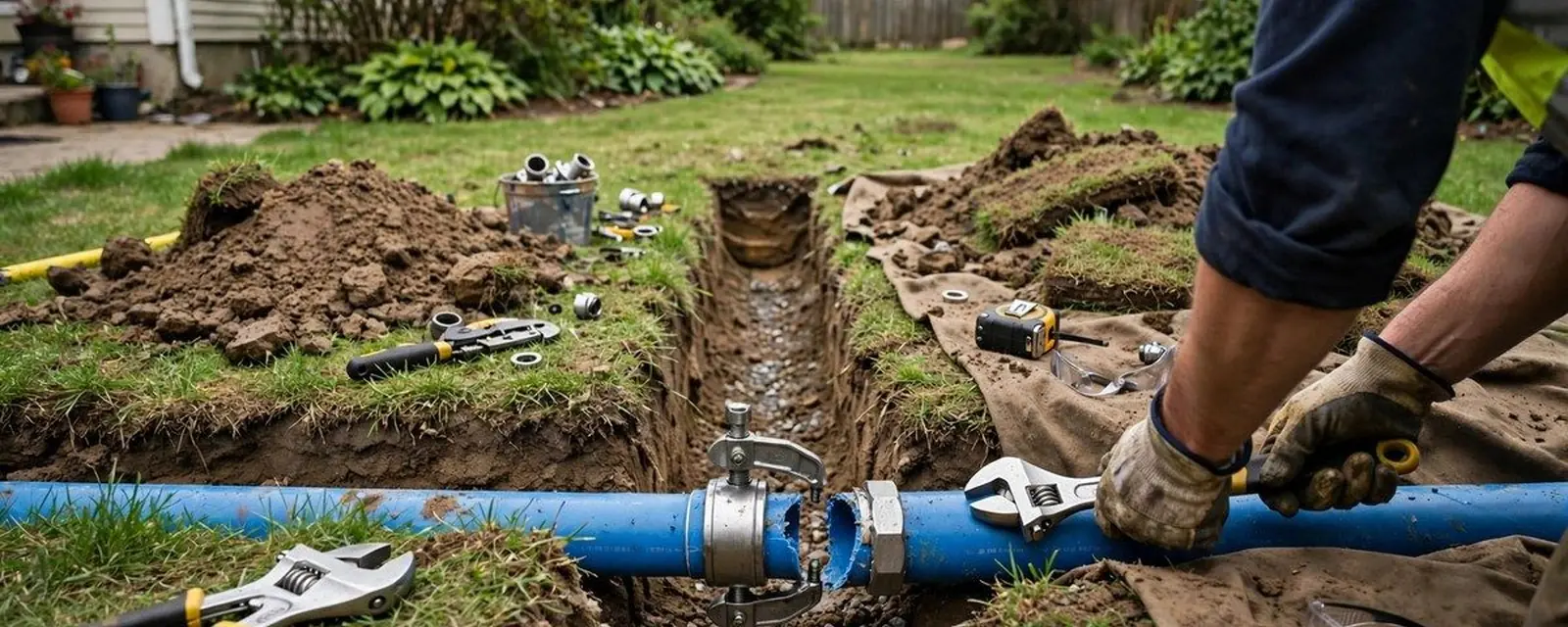
A water service line is the buried pipe that carries water from the main in the street to your house, and in Reynoldsburg, OH it often fails out of sight. Water line repair means finding the break in that pipe, then patching or replacing the damaged length.
If a leak is flooding your yard or your meter is spinning, close the main inside the house and call our 24/7 emergency dispatch. If the shutoff does not hold, keep the area clear and tell us on the phone.
The meter is still moving and the yard looks fine
Most homeowners first notice a buried line leak through the bill, a low-pressure shower or a patch of lawn that stays green and soft in a dry week. Plumbers call that a water service line leak. The pipe is cracked, pulled apart at a joint or corroded through somewhere between the meter and your foundation.
Close every faucet and appliance, then read the meter. If the dial still turns, water is escaping. If it stops when you close your main valve inside, the leak is on the house side of the valve. If it keeps turning with the main shut, the loss is outside, in the buried section.
When a buried line is flooding the yard
Water pouring across a lawn or into a window well from a broken service line is an emergency, and our 24/7 dispatch covers it. Same-day visits are possible for lines that are leaking but contained. Stop what you can from inside first.
- Close the main valve inside the house
- If the main will not close, find the curb stop and leave it to us
- Keep children and pets off soft or sinking ground
- Do not dig in the yard yourself before lines are marked
- Turn off the water heater if the supply stays shut for long
- Photograph the wet area and meter reading
How we find and fix a buried line leak
The work follows the water. We confirm the leak before anyone brings out a shovel.
Isolate the loss
We close fixtures and valves in turn and watch the meter to tell which stretch of pipe is losing water.
Pinpoint it
Listening gear and a line locator narrow the break to a few feet, so the dig stays small.
Call 811
Dig notice goes to OHIO811 first so marked utilities are respected before the ground opens.
Open and cut
We expose the pipe, cut out the bad length and check what is around it for more damage.
Repair and test
New pipe goes in, the line is pressurized and watched, and then the trench is closed.
Meter spinning with everything off?
A licensed plumber can confirm the buried leak and give you a clear plan.
Who owns which part of the line
Part of the service line may belong to the utility and part to you. Columbus lists Reynoldsburg as a water and sewer contract community, so ask your water utility where its responsibility ends before you pay for a repair. Under OHIO811 guidance, privately owned lines are the homeowner's responsibility and may not be marked, so a private locator can be needed.
Underground line leak signs
Buried leaks leave a few clues you can check from the yard and the basement.
Wet patch, no rain
Soft ground along the pipe path, especially between the meter and the house, points to a break close by.
Bill jumps with no cause
A rising bill when nothing in the house changed is the classic buried leak sign.
Sound of running water
A faint hiss near the entry point of the line, heard with every fixture off, is worth a call.
Muddy or discolored water
A break lets soil and sediment into the pipe when pressure drops, which can tint what comes out of the tap.
Damp basement wall
Water following the pipe into the foundation can show up inside as a wet patch on the wall near the entry.
Low water pressure from the line itself
A leak in the service line is one cause of weak pressure, but not the only one. A partly closed shutoff, a clogged pressure regulator or old galvanized pipe narrowed by scale can do the same. The pattern tells us which. Pressure that is low at every fixture and at every hour points to the line or the regulator. Pressure that is low at one tap points to that fixture.
We check pressure with a gauge at an outdoor spigot, watch how it drops when a fixture opens, and then decide where to dig or replace. If the pipe inside is the real choke point, a full repipe may make more sense than any work outside.
Patch, sleeve or replace the buried line
The right fix depends on the pipe, the depth and what is above it.
| Option | Best when | Tradeoff |
|---|---|---|
| Spot repair | One clean break in sound pipe | Quick and cheap, but nearby weak pipe stays in place |
| Replace a section | Corrosion or several breaks in one stretch | More trench and material, a longer-lasting result |
| Full line replacement | Old steel or repeated failures | Largest dig, but ends the repair cycle |
| Trenchless method | Driveway, patio or trees in the way | Less surface damage, but not possible on every route |
| Reroute the line | Original path is blocked or unreachable | New route needs careful layout and notice to utilities |
We explain which of these fit your yard before any digging begins.
Water meter and yard box leaks
Where the line meets the meter, a leak at the connection or inside the box is a different case from a break in the pipe. The meter itself belongs to the utility, so we do not open or repair it. If we see wet soil around the box, we shut off on our side and point you to the right contact.
A damp lid on the meter pit after rain does not always mean a leak. Groundwater and runoff can pool there. Read the meter with everything off, then check again after an hour. That tells you which side to call.
New water lines and main replacement
Sometimes the answer is to install a fresh line rather than repair an old one, for example when a home addition, a detached garage or a new outdoor hookup needs supply. We lay the pipe, set the shutoff and pressure test before the trench closes. Questions on larger main replacement for a street or a property line go to the utility, and we help you ask the right questions.
If the work is part of a bigger project, see our plumbing installation work for how new runs and fixtures get planned together.
Before you call about a suspected leak
These checks take ten minutes and sharpen the diagnosis.
- Turn off every faucet, appliance and ice maker
- Read the meter dial and wait ten minutes
- Close your main valve and read again
- Look for a wet or sunken spot along the yard
- Note when the bill or pressure first changed
- Mark the meter and shutoff locations for us
What changes the cost of a water line repair
A buried line has the widest cost range of any plumbing fix, because the ground decides how hard it is.
Depth and length
A short, shallow break near the foundation is quick. A long run across a yard takes more digging and more pipe.Surface above the line
Lawn is easy to restore. Concrete, pavers and landscaping add demolition and rebuild time.Pipe material
Old galvanized or lead-era fittings need more care. Modern pipe is lighter to handle and faster to join.Method chosen
Open trench and trenchless approaches use different crews and equipment, with different tradeoffs.Utility coordination
Locates and any work on the utility side can add waiting time before the dig starts.Many homeowners policies treat buried line breaks differently from sudden indoor water damage, and some offer an optional add-on. Check your policy before assuming it is covered.
We give you a clear price before work starts. Want your real number? Call (614) 656-1470.
Digging in Franklin County and calling 811
Reynoldsburg sits in Franklin County, with small parts in Fairfield and Licking, so the office that handles inspection can depend on your address. Franklin County Public Health provides plumbing inspection across the county outside Columbus and Grove City, and its Reynoldsburg listing is on its plumbing page. Ask if your repair or replacement needs an inspection before the trench closes.
OHIO811 needs at least 2 working days' notice, not counting weekends, holidays or the day of the call, and no more than 16 calendar days ahead. A burst service line that is flooding your yard is an emergency, so ask us what can be done safely before marks are ready. Most nonurgent digs wait for the marks.
Questions about water line repair
Yes. Our 24/7 dispatch covers a broken service line at any hour. We close what we can on the house side, locate the loss and set up a plan. A trench dig for a nonurgent repair waits for OHIO811 marks, since Ohio law requires notice before digging.
Shut the main valve inside, then watch the meter. If it keeps moving, the loss is in the buried line. If it stops, the leak is inside. A wet spot in the yard or a hiss near the entry point supports the outdoor theory. For a closer look, see our leak detection service.
It depends on where the utility's ownership ends, and that point varies. Ask your water utility. Under OHIO811 guidance, privately owned lines belong to the homeowner and may not be marked. We can help you find where your pipe changes hands.
Sometimes. Trenchless methods can pull a new line through the old path with only a couple of access pits. The route has to be straight enough and the old pipe in suitable shape, so we check before we promise anything.
Work on the utility's own main belongs to the utility. We handle the private line from the shutoff to your house, and we help you speak to the right office when the problem sits on the street side.
A leak in the service line, a failing pressure regulator, a partly closed valve or scale in old steel pipe can all do it. We measure pressure at an outdoor spigot, then trace it upward until we find where it drops.
Also serving nearby towns
Dispatch for this service runs from Reynoldsburg to the towns below.