
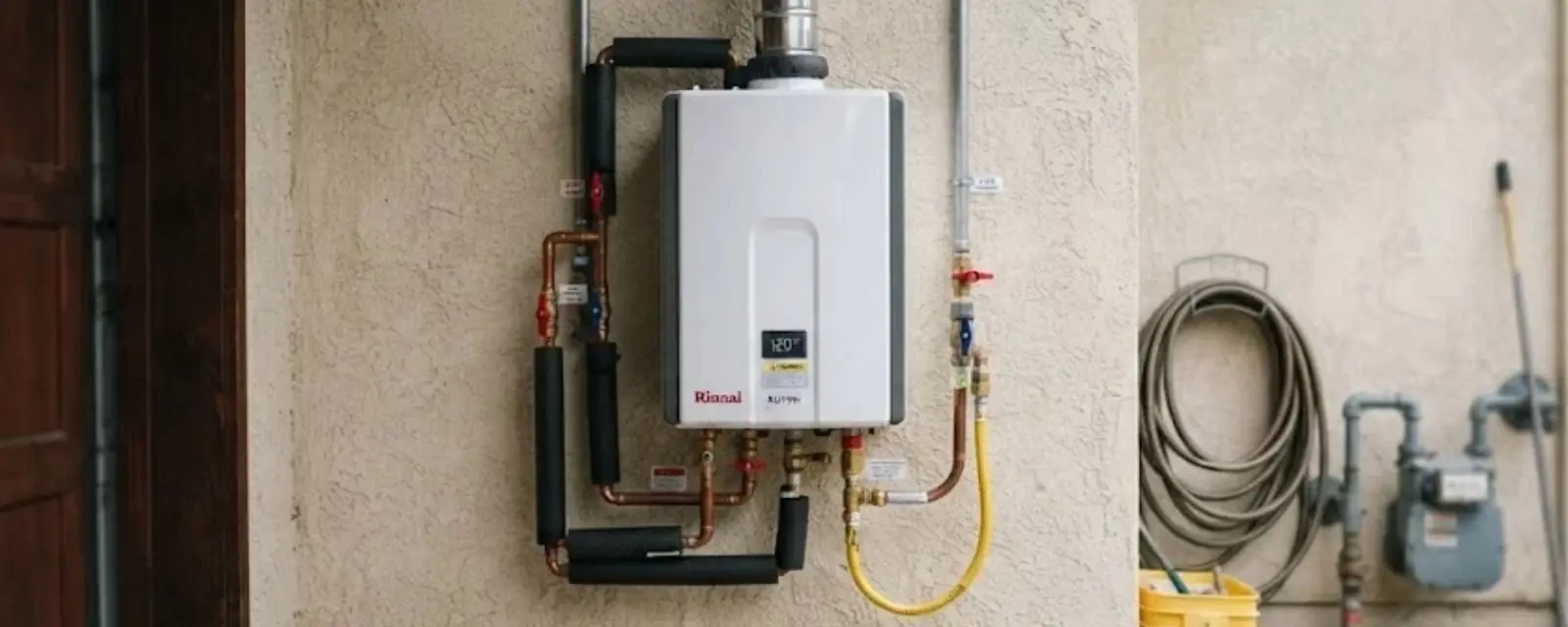
A tankless water heater in Reynoldsburg, OH heats water on demand as it flows through a compact heat exchanger, so there is no tank to store or run out. The tradeoff is that the exchanger has narrow passages that minerals love to coat. Our licensed plumbers install tankless units, service them, and flush them.
If yours has started to rumble, show a code, or deliver water that never quite gets hot, the cause is often scale, a clogged inlet filter, or a flow setting. Urgent problems can still be called in 24/7.
My tankless heater needs service: what the symptoms mean
People describe the same few problems in different words. The water goes lukewarm on the second shower. A display flashes a number. The unit clicks and shuts off in the middle of rinsing hair. A kettle-like rumble starts a few years after the install, and the pipes near the unit feel hot to touch long after use.
Those are the signs of an overdue descale. Scale thickens the walls of the heat exchanger, so heat transfer drops, the unit overheats, and a safety sensor cuts the burner. Cleaning the exchanger is the technical fix, and what you are really measuring is time since the install and how much water has flowed through it.
Tankless flush and descale: the procedure
A proper flush is a circulation job, not a rinse, and takes about an hour per unit once the connections are ready.
Power down
Gas or electric supply is shut off and the unit cools. Burn injuries are the main risk, so we never start on a warm exchanger.
Isolate
Service valves on the cold and hot lines are closed, and the drain caps are opened. Without isolation valves, we can add them first.
Hook up the pump
A small pump and hoses connect to the two service ports, drawing from a bucket of the descaling solution the maker allows.
Circulate
Solution runs through the exchanger for roughly forty-five minutes. Foaming and cloudy fluid are signs that scale is dissolving.
Rinse and clean the filter
We flush with clean water, clear the inlet screen, open the valves, purge air, and check temperature and flow at a tap.
Tankless overdue for a flush?
A licensed plumber can service the unit and tell you what the scale has done.
Why Reynoldsburg water leaves scale in a tankless heat exchanger
Columbus softens its water on average to 120 ppm, about 7 grains per gallon, and Reynoldsburg is listed among its water and sewer contract communities. That is softer than raw groundwater but not soft. Heat drives dissolved minerals out of the water onto the nearest hot surface, which is the exchanger.
In practice this means a tankless heater here should be flushed on a schedule, and the manual's interval is a ceiling, not a target. Check the inlet screen at each service. The Columbus Division of Water publishes a Consumer Confidence Report that shows what is in your supply, and your plumber can use it when advising on a conditioner.
Tankless problems and their usual causes
Most calls fall into a short list, and the first checks are cheap.
Cold sandwich
Short pauses between uses let the line cool, so the next draw starts with a slug of cold water. A recirculation line or small buffer tank can help.
Minimum flow shutoff
A low-flow faucet may not open the flow sensor. The unit never fires, and the water stays cold.
Error codes
Codes typically point at ignition, exhaust, flow, or temperature sensors. Scale is a frequent hidden cause.
Rumble or kettle noise
Steam pockets form behind scale. It is a warning, and flushing usually quiets it.
Lukewarm at distance
Long pipe runs bleed heat before it reaches the shower. The unit may be fine.
Tankless against a storage tank
Neither option is wrong, and the right one depends on your house.
Tankless strengths
- No standby heat loss from a stored tank
- Hot water does not run out during a long soak
- Wall-hung unit frees up floor space
- Parts are individually replaceable over time
Tankless costs of ownership
- Larger gas line or heavy electrical service often required
- Vent type and routing change from a tank's
- Needs regular descaling to hold performance
- Cold sandwich and minimum flow quirks can annoy
Gas, electric, and condensing tankless units
The type changes what the house must supply.
| Type | What it needs | Watch for |
|---|---|---|
| Gas, non-condensing | Gas line sized for the burner, metal vent | Hot flue gas, higher venting demands |
| Gas, condensing | Gas line, plastic vent, condensate drain | Clogged condensate trap |
| Electric | Large dedicated circuit, often multiple breakers | Panel capacity limits |
| Point of use | Small electric unit near one fixture | Only one tap at a time |
Sizing a tankless unit takes more than a label
A tankless heater is rated in gallons per minute at a given temperature rise. In winter, incoming water is colder and the unit has to work harder to deliver the same flow, so a model that is right in August can come up short in January. We total the fixtures that run together and size to that.
Our water heater installation work covers the venting and fuel details, and the unit should not be picked until a plumber has seen the gas meter and the vent path.
When a water conditioner makes sense
A conditioner or softener ahead of a tankless unit slows the scale that coats the exchanger. It does not remove the need for service. For a straight view of what treatment does and does not do, see our water softener and filtration page.
Before you schedule a flush or service
Gathering these saves time on the visit.
- Brand, model, and the date of installation
- Any code shown on the display and when it appeared
- Whether service valves are already installed
- Whether the unit is gas or electric
- Any rumbling, clicking, or temperature swings you have noticed
- Whether a repair of a failed part is also needed
What affects the cost of tankless service or installation
Service is priced differently from a new install, but the drivers overlap.
Service valves present or missing
A unit with isolation valves flushes quickly. Without them, adding valves is part of the first visit.How much scale has built up
A neglected exchanger may need longer circulation or a repeat flush before it recovers.Unit type and capacity
Condensing, high-capacity, and electric tankless models differ in parts and installation work.Gas line and vent changes
A switch from tank to tankless often needs a bigger gas line and new venting.Parts if a sensor has failed
Scale can damage a thermistor or flow sensor, and the part cost depends on the maker.Insurance does not pay for maintenance or descaling. A sudden leak from the unit may fall under a policy, depending on its terms, so check with your insurer.
We explain the price before work starts. Want your real number? Call (614) 656-1470.
Questions about tankless water heater
Many makers call for roughly yearly descaling in hard water, and our Columbus supply sits around 7 grains per gallon. Check the manual, then shorten the interval if you see rumbling, falling temperatures, or error codes. A clean inlet screen and a working flush schedule are cheaper than a replaced heat exchanger.
Some owners do, if isolation valves are fitted and the manual allows the solution. Risks include burns from a hot exchanger, gas or power left on, and mixing the wrong chemical. If valves are missing, or you smell gas, stop. In the case of gas, leave the building and call the gas utility or 911.
Codes are the unit's way of pointing at ignition, flow, exhaust, or temperature. Scale often hides behind them, so a flush is the first low-risk step. Write down the code, then call. We can match it to the model and decide whether it needs a part. Our water heater repair page explains the diagnosis.
That is the cold sandwich. Water in the pipe cooled between uses and reaches your tap before the heater's fresh hot water. A recirculation line, a small buffer tank, or a faster draw pattern helps. It is a design trait more than a fault.
Possibly, if you value endless hot water and wall space and your house can supply the gas or power. The gain in energy savings depends on usage, and installation work can be larger than a tank swap. A site visit is the honest way to answer.
A gas line of adequate size or a large electrical circuit, an approved vent, a condensate path for condensing models, and isolation valves for service. Our plumbing installation service can look at the existing lines. Ask Franklin County Public Health or your plumber whether a permit applies.
Also serving nearby towns
Dispatch for this service runs from Reynoldsburg to the towns below.