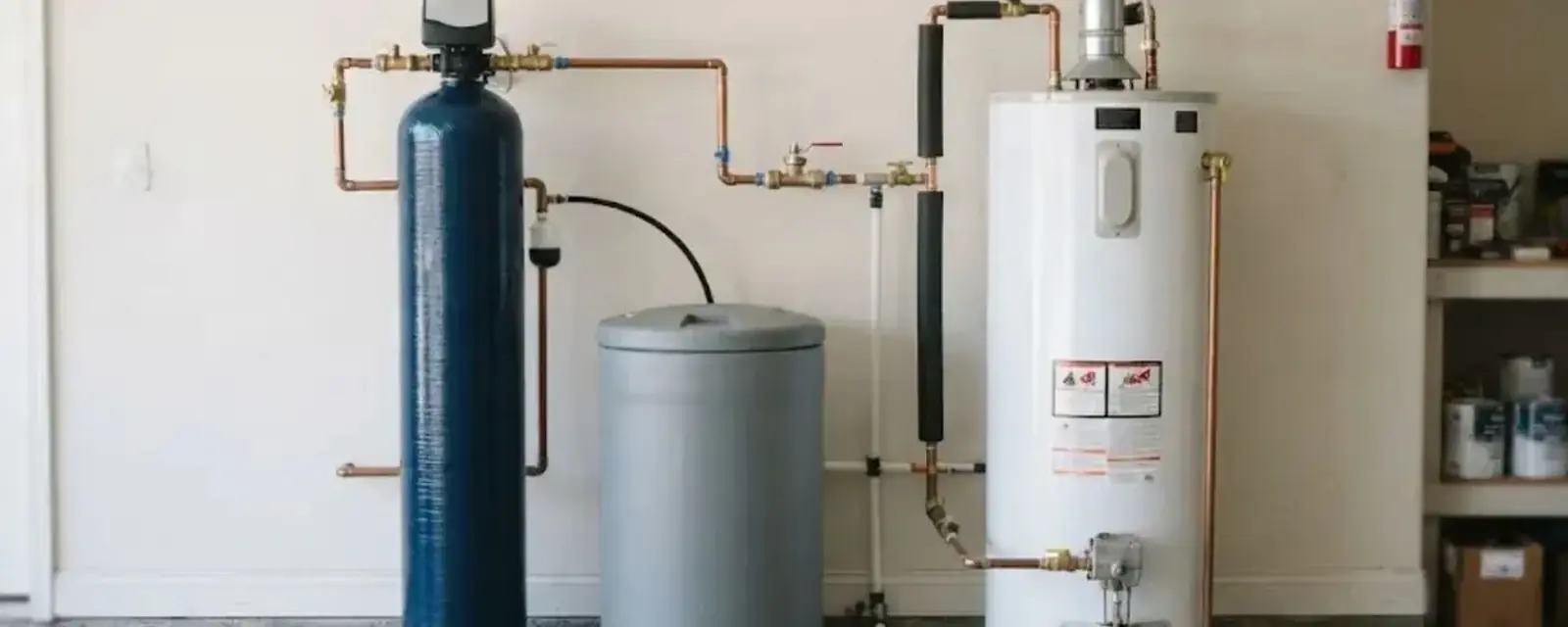
A water softener swaps hardness minerals for sodium or potassium inside a resin tank, and a filter removes particles, chlorine taste or odor. In Reynoldsburg, OH, many homeowners ask whether they need either one.
The honest answer is that it depends on what bothers you. Columbus softens its water before delivery, so your starting water is already moderate. We install and repair these systems, and we will tell you if you can skip one.
Columbus already softens the water you buy
According to the Columbus Division of Water, Columbus softens its water on average to 120 parts per million, or approximately 7 grains per gallon. Columbus lists Reynoldsburg as a water and sewer contract community. Read the Water for Living Consumer Confidence Report for current figures. So a home softener goes further than the city, and is a choice about spots, soap feel and scale, not an emergency.
Why some homes still want one
Moderate water still leaves scale on faucets, a film on shower glass and white crust inside kettles. Water at roughly 7 grains still builds slowly inside a tank heater or a tankless unit. Some people also dislike how soap feels in moderately hard water, and a softener changes that.
Others find the maintenance, the salt and the extra sodium not worth it. That is a fair call. A softener adds a tank, a drain connection and a monthly chore, and it uses some water to regenerate. We would rather explain the tradeoffs than sell one.
Softener or carbon filter
These solve different problems, and homeowners often mix them up.
Softener fits when
- You see scale on fixtures and glass
- You want softer feeling water at every tap
- You accept salt refills and a drain line
- You protect a tank or tankless heater from scale
Filter fits when
- You dislike chlorine taste or smell
- You want sediment removed
- You want no salt and little upkeep
- You want one tap or the whole house treated
Unsure you need one at all?
Describe what you see at the tap and we will tell you straight.
Systems we install and service
Here is a plain sort of the common options.
| System | What it does | Maintenance |
|---|---|---|
| Salt-based softener | Removes hardness minerals by ion exchange | Add salt, clean the brine tank, set the regeneration |
| Whole-house carbon filter | Cuts chlorine taste and odor | Replace media or cartridges on a schedule |
| Sediment filter | Catches sand and rust particles | Change the cartridge regularly |
| Under-sink filter | Treats drinking water at one tap | Swap the cartridge on its own schedule |
| Scale reducer | Changes how scale forms rather than removing it | Minimal, but results vary by water |
We help you match the system to the complaint, not the other way around.
What a softener install involves
A softener is plumbing work, and the layout matters.
Pick the spot
The unit needs space, power, a drain and a place near the water entry.
Plan the bypass
A bypass valve lets you isolate the unit for service without shutting off water.
Keep outdoor taps raw
We usually leave outdoor spigots and some cold lines untreated.
Connect and flush
Piping goes in, the drain is set with an air gap and the media is flushed.
Program it
We set the regeneration for your household use and walk you through the salt.
Repairing a water conditioner
Softeners fail in a few ways. A salt bridge forms a crust inside the brine tank and keeps salt from dissolving. A clogged injector or a worn valve stops regeneration. A resin bed that has worn out lets hardness through no matter how much salt you add.
If the water has gone hard, the first check is whether the tank has salt and whether it regenerates. We also check the bypass valve and the drain line. A broken valve or a tired resin bed is a repair decision, and for an old unit it can lead to replacement instead.
Before you call about softener trouble
Check these first, since several are easy fixes.
- Confirm the unit has power and a lit display
- Look for salt, and poke the pile for a crust
- Check that the bypass valve is not left open
- Note the date it last regenerated
- Watch the drain line for a steady trickle
- Test a tap for soap feel and spotting
What affects softener and filter cost
The system and the plumbing layout drive the price.
Type of system
A softener, a carbon filter and a combined setup each use different equipment.Capacity
Larger households need larger resin tanks and more frequent regeneration.Plumbing changes
Tight spaces, long runs and drain access change the install labor.Existing equipment
A repair on a working unit is smaller than a new install.Water treatment equipment is generally a home improvement and not an insured repair, so coverage is rare. Ask your insurer or home warranty provider if you are unsure.
We give you a clear price before work starts. Want your real number? Call (614) 656-1470.
Reynoldsburg water in practice
Reynoldsburg buys Columbus water, which draws on three reservoirs named Griggs, O'Shaughnessy and Hoover. That means your water quality follows what the city reports, so look at the Consumer Confidence Report before buying anything. If your complaint is taste or smell, a filter may suit better than a softener.
If you want to protect a new tank or tankless unit, see how scale affects tankless units. Planning a heater at the same time? Our water heater installation work can include the softener layout.
Questions about water softener & filtration
Not necessarily. Columbus softens its water on average to about 7 grains per gallon, so scale is moderate. A home softener is a choice about spotting, soap feel and scale in heaters. If those do not bother you, skipping it is reasonable.
Not really. A softener removes hardness minerals, not chlorine taste or odor. A carbon filter handles taste and smell. Many homes pair both, but they solve different complaints, so decide which one matters to you.
Common causes are no salt, a salt bridge, a clogged injector, a bypass left open or a worn resin bed. We start with the easy checks, then test the valve and regeneration cycle.
It can slow scale on a tank bottom or a tankless heat exchanger. It does not replace flushing and routine care. Our page on faucet repair also covers how scale clogs aerators and cartridges.
Usually yes. We look at the valve head, the brine tank, the injector and the bypass. If parts are no longer available or the resin is worn out, we tell you plainly.
Also serving nearby towns
Dispatch for this service runs from Reynoldsburg to the towns below.