
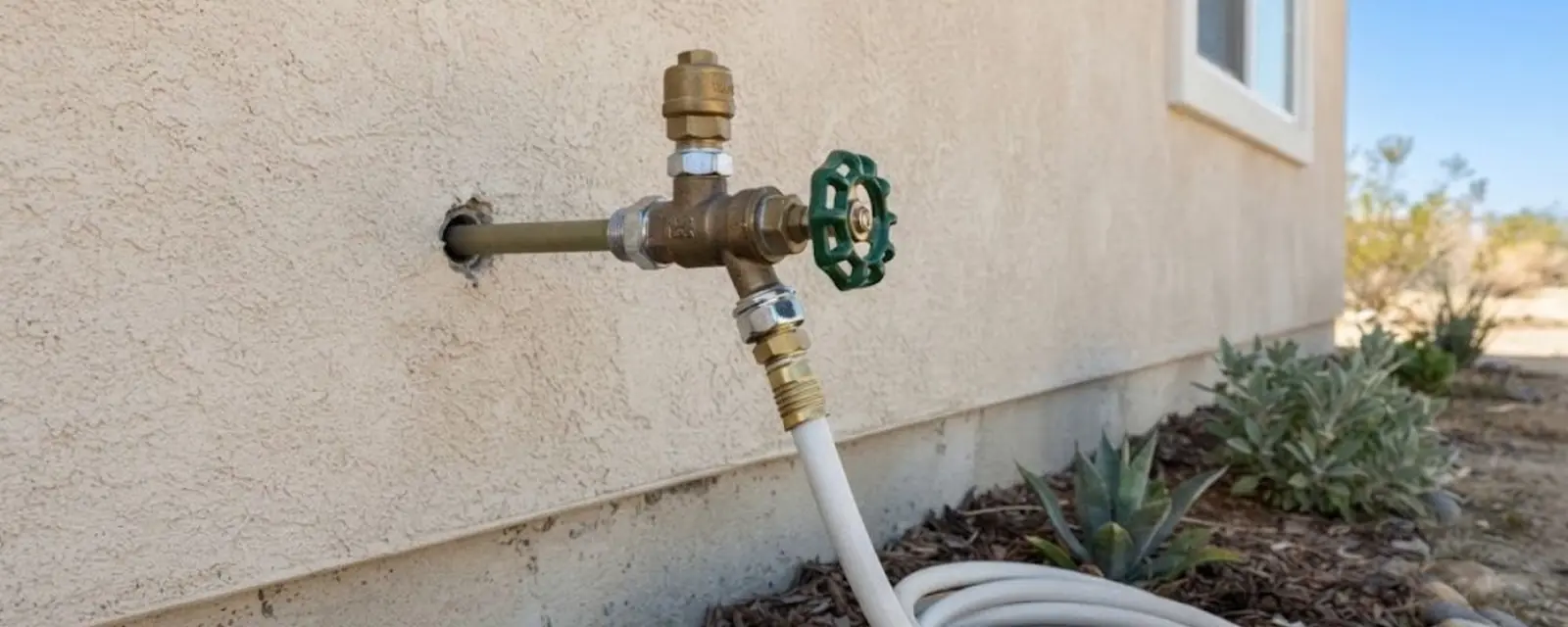
An outdoor faucet valve is the shutoff mechanism behind your hose bib, and most leaks come from a worn packing washer, a bad stem seat, or a cracked body. In Reynoldsburg, OH, a drip at the spigot is often a ten minute fix with a screwdriver and a handful of small parts. A spray from the wall, or water showing up inside the house, is a different story, and this guide tells you where that line sits.
Read the leak before you touch a wrench
Where the water appears tells you which part has failed. Spend two minutes watching the faucet with the handle open and then closed.
Drip from the spout
The seat washer or the seat itself is worn. Water slips past even when the handle is fully closed.
Leak under the handle
The packing nut or packing washer has dried out. The leak shows only when the faucet is turned on.
Water behind the faucet
Check the wall face and the basement ceiling below. This points to a failed joint or a cracked pipe, not the valve.
Handle spins freely
The stem threads are stripped or the handle screw has backed out. The valve may be fine.
Hose connection weeps
Often just a cracked rubber hose washer. Swap it before you blame the valve.
Tools and parts to gather first
Most repairs need nothing exotic. Lay everything out on a towel so small parts do not roll into the grass.
- Adjustable wrench and a pair of channel lock pliers
- Flat and Phillips screwdrivers for the handle screw
- Assorted faucet washers and a packing washer kit
- Plumber's tape and a few rags for drips
- Bucket, a small flashlight, and a replacement handle if needed
- Penetrating oil for a stuck packing nut
Replacing the packing and seat washer
This sequence works on the common compression style hose bib found on many older homes.
Close the supply
Find the indoor shutoff for the exterior line, usually in a basement or utility space. Turn it fully off, then open the outdoor faucet to drain what is left.
Loosen the packing nut
Remove the handle screw and handle. Use the wrench on the packing nut just under it, and turn it counterclockwise a half turn at a time.
Pull the stem
Unscrew the stem with the faucet open and lift it straight out. The seat washer sits on the inner end, held by a small brass screw.
Swap the washers
Replace the seat washer and the packing washer with matching sizes. Take the old stem to the hardware store so you can match it exactly.
Reassemble and test
Snug the packing nut, restore the supply slowly, and watch for seeping at the stem. Tighten a quarter turn only if it weeps.
Why a closed faucet can still burst a pipe
A hose left attached holds water inside the valve, and that water freezes first. Ice expands, and the split often forms in the pipe a few inches inside the wall, not in the faucet you can see. You will not notice until the thaw, when water sprays behind the siding or into the ceiling below. Pull hoses off before the first hard freeze and drain the line from the indoor shutoff.
Repair, replace, or call: a quick decision guide
Use this to match what you see with the right next move.
| What you see | Likely cause | Best move |
|---|---|---|
| Slow drip at spout, handle closed | Worn seat washer | Replace the washer yourself |
| Weeping around the handle stem | Dry packing | Tighten or replace the packing |
| Valve body corroded or cracked | Age or past freeze damage | Replace the whole faucet |
| Water inside the house after a thaw | Split pipe in the wall | Shut off the supply and call a plumber |
| Handle stuck or snaps off | Mineral buildup or stripped stem | Try penetrating oil once, then call |
Anything that involves cutting into pipe or opening a wall is beyond a weekend repair.
When a frost-proof sillcock is the better answer
A frost-proof sillcock has a long stem that seats the washer deep inside the heated part of the house. Because the shutoff happens inside the wall, there is no standing water at the exterior face to freeze. If your current faucet is a short, standard hose bib, swapping to a long-stem model removes most of the winter risk.
The catch is installation. These units must tilt slightly downward so they drain, and the supply pipe has to be cut and re-soldered or joined with a push fitting. That is why we handle most conversions through our faucet repair and replacement work rather than leaving a half-finished swap on a Saturday afternoon.
After a freeze: checking for a hidden split
When a pipe splits in winter, the ice acts as a plug. The leak starts only after the weather warms. Turn the outdoor faucet on in spring with the indoor valve open, then walk inside and look at the ceiling, the wall below the faucet, and the floor joists nearby.
If you see a stain, a drip, or hear water running when every fixture is off, close the main supply right away. Our team treats an active leak like this as a burst pipe repair call, and 24/7 emergency dispatch exists for exactly this kind of discovery on a Sunday night.
We dispatch from Reynoldsburg to homeowners in Gahanna and neighbors in Whitehall, so the same crew can look at an exterior wall leak in either town.
Mistakes that turn a small drip into a big repair
Overtightening is the classic one. Cranking the packing nut with a long wrench can crack the brass body or strip the threads, and then a ten minute washer swap becomes a full replacement. Snug is enough. Teflon tape on the pipe threads, not on the stem threads, is the other common error.
Another is working with the supply still on. Even a slow leak can turn into a jet once the stem comes out. Always shut the indoor valve first, and keep a bucket under the work area in case the line holds more water than you expect.
Reynoldsburg note: what the county says about faucet swaps
Franklin County Public Health provides plumbing inspection for Reynoldsburg and says no permit is needed for replacement of a faucet. That means swapping an outdoor faucet for a like model generally does not trigger the paperwork a larger job would. If your project grows into new pipe runs, call the FCPH plumbing office before you start.
Reynoldsburg also sits partly in Fairfield and Licking counties, so confirm which office handles your address before you assume the Franklin County rules apply to your lot. A quick call saves a rework later.
Source type: Franklin County Public Health plumbing page, plus Wikipedia (secondary) for county boundaries.
Quick answers
A drip from the spout or a weep at the handle usually means a washer or packing fix. If the brass body is corroded, the stem will not turn, or you see cracks, replace the whole faucet. Water behind the wall points to a pipe problem, not a valve problem.
No. Shut off the indoor supply to that line first and open the outdoor faucet to drain it. Pulling the stem with pressure on the line sends water straight at you and soaks the siding. Keep a bucket and towels handy for the last bit of water in the pipe.
Look at the length. A frost-proof sillcock is long, often six inches or more from the wall to the handle, and tilts slightly down. A short, stubby faucet is standard and keeps water near the exterior wall, which is where winter freeze damage starts.
Franklin County Public Health says no permit is needed for replacement of a faucet, but check with the plumbing office if your property sits in the Fairfield or Licking county portion of Reynoldsburg, or if the job involves new piping.
Close the main water shutoff immediately, then open a low fixture to drain the line. Do not wait for the drip to stop. Water inside a wall can ruin drywall and insulation fast, so treat it as an urgent repair.