Most clogged toilets and jammed disposals in Reynoldsburg, OH homes trace back to what went in, not a failing part. A toilet is built to move waste and toilet paper only. A disposal is built to chop soft food scraps into particles small enough to wash away.
This guide covers what belongs in each, what does not, how to free a stuck unit safely, and the point where a plumber is the safer choice. Prevention takes a few small habits and costs almost nothing.
Why toilets clog in the first place
The toilet trap is a curved passage inside the bowl, only about two inches wide in many models. Anything bulky, such as wipes, cotton swabs, or a thick wad of paper, can catch in that bend. Modern toilets also use less water per flush, so they have less force to push a heavy load through.
Wipes sold as flushable are the biggest offender. They do not break apart like paper. They tangle with hair and grease further down the line and can build a mat that a plunger will not move.
What goes where
Keep this in mind at the toilet and at the sink. Everything else belongs in the trash.
Safe for the toilet
- Human waste
- Standard toilet paper in modest amounts
- Nothing else, not even tissues
- Water, as the carrier
Safe for the disposal
- Soft, small food scraps
- Cold running water as you grind
- A few citrus peels for odor
- Ice cubes occasionally for blades
Never put these down the drain or toilet
These items cause the majority of the clogs plumbers see.
- Flushable wipes, baby wipes, and makeup pads
- Cotton swabs, dental floss, and cotton balls
- Feminine products, diapers, and paper towels
- Coffee grounds, eggshells, and pasta or rice
- Potato peels, celery, and other stringy vegetables
- Grease, oil, and fat from cooking
- Bones, fruit pits, and corn husks
- Cat litter, even the kind labeled flushable
Freeing a stuck disposal safely
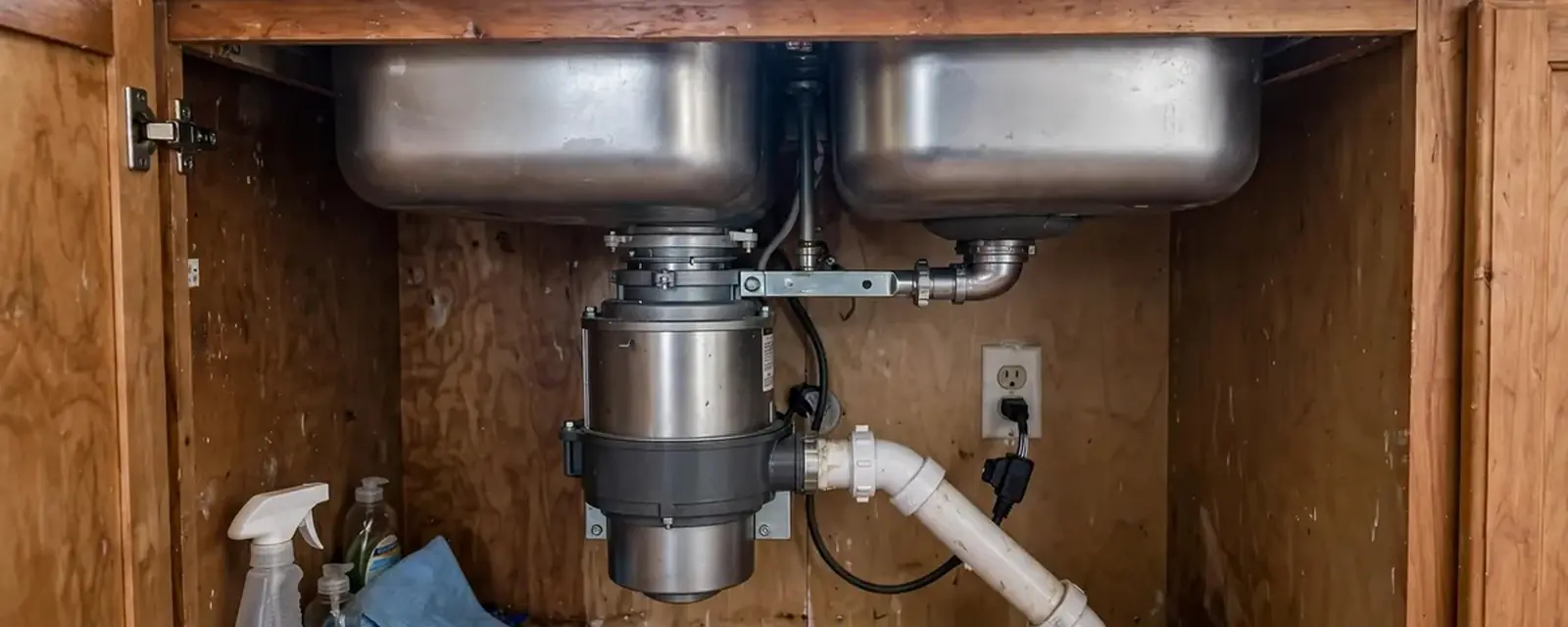
A humming disposal that will not spin is jammed. Do not put your hand inside it.
Cut the power
Switch off the wall switch and unplug the unit under the sink if you can reach the cord. Never trust the switch alone.
Look from above
Shine a flashlight into the drain opening. If you can see a spoon, bottle cap, or bone, pull it out with tongs or pliers.
Turn the flywheel
Most units have a hex socket on the underside. Insert the wrench that came with it and work it back and forth until it turns freely.
Press the reset
A small red button on the bottom pops out when the motor overheats. Press it in after the unit has cooled for a few minutes.
Test with water
Restore power, run cold water, and flip the switch. If it hums again, stop and call a plumber.
Quick fixes for a clogged toilet
Match the fix to the sign. Stop if water rises toward the rim.
| What you see | First move | When to stop |
|---|---|---|
| Bowl drains slowly | Plunge with a flange plunger and a firm seal | If it takes more than a few tries |
| Bowl rises, does not drain | Close the supply valve, do not flush again | If water nears the rim |
| Gurgling in tub or sink | Plunge once, then check other drains | Call if multiple fixtures react |
| Repeat clogs every few weeks | Check for a partial blockage or a worn flapper | Call for a camera look |
A flange plunger, the kind with a soft rubber flap, seals the toilet outlet better than a flat cup plunger.
When the problem is the toilet itself
Some toilets clog repeatedly even with good habits. Older low-flow models may have weak flush power, and a cracked trap, loose wax ring, or partial blockage in the drain can add to it. A plumber can check whether the toilet is the problem or the line behind it.
Our toilet repair visits cover flappers, fill valves, and seals, and we also tell you honestly when a repair is not worth it and a new toilet makes more sense.
Disposal habits that prevent jams
Run cold water before, during, and for about fifteen seconds after grinding. Cold water keeps grease firm so the blades can chop it, and the extra flush carries particles past the trap. Feed scraps in small amounts instead of one big pile.
If the unit hums, smells, or has started leaking at the bottom, it is wearing out. Our garbage disposal repair covers jams, leaks, and replacements, and a leaking housing generally means replacement rather than a patch.
Households we help nearby
We hear the same pattern from families in Pickerington and Whitehall: one clog gets blamed on a bad toilet or a bad disposal, then the real cause turns out to be wipes, grease, or a tired fixture. We dispatch to Pickerington and Whitehall from Reynoldsburg and offer same-day appointments when available.
Reynoldsburg note: swapping a toilet or sink
Franklin County Public Health provides plumbing inspection for most of Franklin County, and its plumbing page lists Reynoldsburg among the jurisdictions it covers. The same page says no permit is needed for replacement of a faucet, sink, or toilet. If your repeated clogs end with a replacement, that is a useful fact to carry in.
The practical point: a like-for-like toilet swap does not usually start with a permit application. For anything bigger, such as moving a drain or adding a fixture, ask FCPH through its online inspection request form or ask your plumber whether a permit applies.
Source type: Franklin County Public Health plumbing page.
Quick answers
No. They do not break down quickly the way toilet paper does, and they tangle with hair and grease in the pipe. Put them in the trash. Plumbers see them as a leading cause of repeat toilet and main line clogs.
Avoid it. Grounds settle into a paste in the trap and can slowly narrow the pipe. Use the trash or a compost bin. Small amounts rinse through, but regular use builds up over time.
Skip it. Chemical cleaners can crack porcelain, damage seals, and leave a hazardous bowl for the person who plunges next. A plunger or closet auger works better and is safer.
Food film clings to the grind ring and the rubber splash guard. Scrub the guard with a brush and dish soap, then grind a few ice cubes with a citrus peel. Persistent odor with a clean unit can point to a drain problem past the disposal.
Franklin County Public Health says no permit is needed to replace a faucet, sink, or toilet (water closet). For other work, ask FCPH through its online inspection request form or ask your plumber whether a permit applies.