
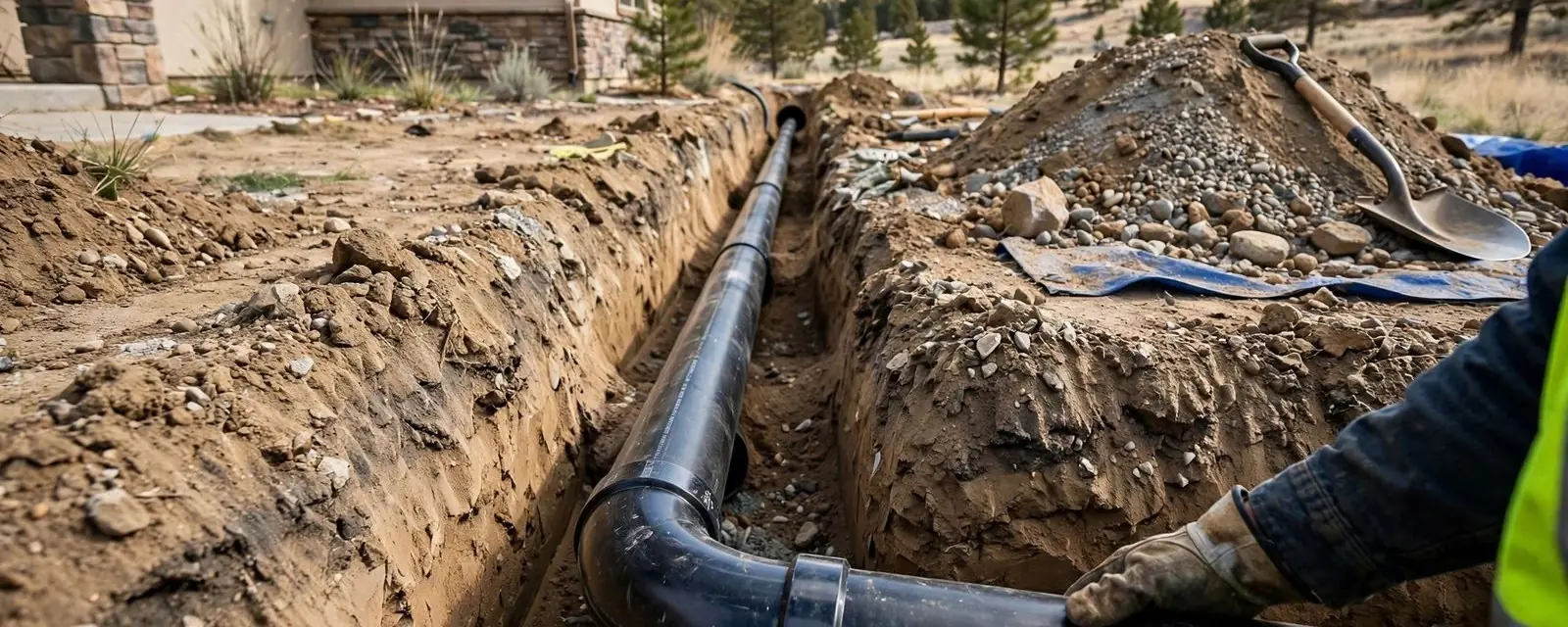
Sewer pipe line repair in Reynoldsburg, OH starts with finding out what is wrong, not with digging. The lateral that runs from your house to the main can crack, shift at a joint, sag into a belly, or fill with tree roots. Each of those has a different fix, and a camera inspection tells you which one you have.
This guide covers the signs, the repair options and their tradeoffs, and the legal step that comes before any shovel goes in the ground.
Signs the sewer line is failing
One sign can be a simple clog. Two or three together point at the line itself.
Slow drains everywhere
Every fixture is sluggish, not just one sink or tub.
Gurgling toilets
Air is pushed back through traps when flow is restricted.
Sewage smell in the yard
A cracked pipe can leak gas and waste into the soil.
Soggy or sunken lawn
A wet patch or dip over the pipe route may mark a break.
Repeat clogs
Cleaning helps for a few weeks, then the problem returns.
Basement backup
Waste rises in the lowest drain when the line is fully blocked.
How the diagnosis goes
A good repair plan begins with evidence.
Clear the line
We run a cable or jet so the camera can see the pipe wall.
Run the camera
A small camera on a flexible rod records the pipe from the cleanout inward.
Locate the fault
A locator on the surface marks the depth and position of the problem.
Choose the method
We discuss spot repair, lining, or replacement based on the footage.
Quote the work
You get a clear price before work starts, tied to what the camera showed.
Repair methods compared
The right option depends on the damage, the depth, and what sits above the pipe.
| Method | Best for | Tradeoff |
|---|---|---|
| Spot repair | One broken section or offset joint | Needs a small dig, may leave other weak spots |
| Pipe lining | Cracks and roots in an otherwise straight pipe | Does not fix a collapsed or bellied section |
| Pipe bursting | Old pipe that must be replaced with a new one | Needs access pits at each end |
| Open trench replacement | Collapsed or badly sagging pipe | Most disruption to yard and driveway |
| Root cutting and jetting | Roots as the main cause | Temporary if the pipe is cracked |
Why sewer lines fail in the first place
Older lateral materials such as clay and cast iron break down at joints, which lets roots in. Newer plastic pipe can still sag if the trench settles or if a heavy load sits over it. Ground movement, a nearby tree, or years of grease can each play a part.
That is why a repair quote without a camera recording deserves a second look. The pipe cannot tell you what failed, but the footage can, and it also shows whether the rest of the run is sound enough to leave alone.
What you can do yourself and what to leave
There is a short list of safe steps. Everything involving digging or raw sewage is not on it.
Safe for the homeowner
- Locate the cleanout cap and keep it clear
- Stop flushing wipes and pouring grease
- Cut back tree roots near the yard line
- Note the dates and fixtures of each backup
Leave to a licensed plumber
- Opening a cleanout during a backup
- Any excavation near the sewer line
- Cutting or lining a pipe
- Handling waste in a flooded basement
If waste is coming up right now
Stop running water in the house, since every drain feeds the same line. Keep children and pets out of the area, and avoid touching the contaminated water. Open windows if the smell is strong, and do not use electrical devices in a flooded space.
Our sewer line repair work and the camera checks in sewer inspection visits both start from that moment. We take emergency calls 24/7, and we serve Pickerington and Gahanna as well as Reynoldsburg.
Preventing the next failure
After a repair, the habits matter. Wipes labeled flushable do not break down, and grease hardens in the lateral and catches everything behind it. Keep a clear cap on the cleanout, and plant new trees well away from the pipe route.
A camera look every few years, especially on clay or cast iron, on an older line is cheap compared with a surprise backup. It also gives you a record of the pipe's condition when you sell the house or file an insurance question.
Cost comes from depth, length, and what is above
The price of a sewer repair moves with how deep the pipe sits, how long the damaged section is, what covers it, and how easy it is to reach. A line under a lawn is a different job from one under a driveway or patio. Real numbers come only after the camera shows the break, so be wary of fixed prices given over the phone.
Reynoldsburg note: call OHIO811 before any dig
Ohio law requires whoever digs to notify OHIO811 first, by dialing 811. The notice must be given at least 2 working days ahead, not counting the call day, weekends, or legal holidays, and no more than 16 calendar days ahead. The contractor doing the work makes that notification, so ask yours to confirm it.
Utilities mark the lines they own. Privately owned lines, including some service lines, may not be marked, and OHIO811 says they are the responsibility of the homeowner, so a private locator may be needed. For a sewer repair, that means a lateral can sit unmarked, and the camera locator is how we find it.
Source type: OHIO811 homeowner page (oups.org).
Quick answers
A clog usually affects one fixture and clears with a cable. A broken line causes repeated backups in several drains, sewage smells, or wet ground in the yard. A camera inspection settles it.
Yes. Roots seek moisture and enter at cracked or loose joints, then grow and block the pipe. Cutting them clears flow, but the opening they used stays until the pipe is repaired or lined.
No. Lining works in a pipe that is still round and mostly straight. A collapsed section or deep belly needs repair or replacement, and the camera footage shows which case applies.
It depends on your policy and whether the damage was sudden or gradual. Many policies exclude wear and root damage. Ask your insurer before the work starts and keep the camera footage.
Yes. Ohio law requires notifying OHIO811 before digging, at 811, with at least 2 working days of notice. Your contractor makes the call, and private lines may still need a private locator.