
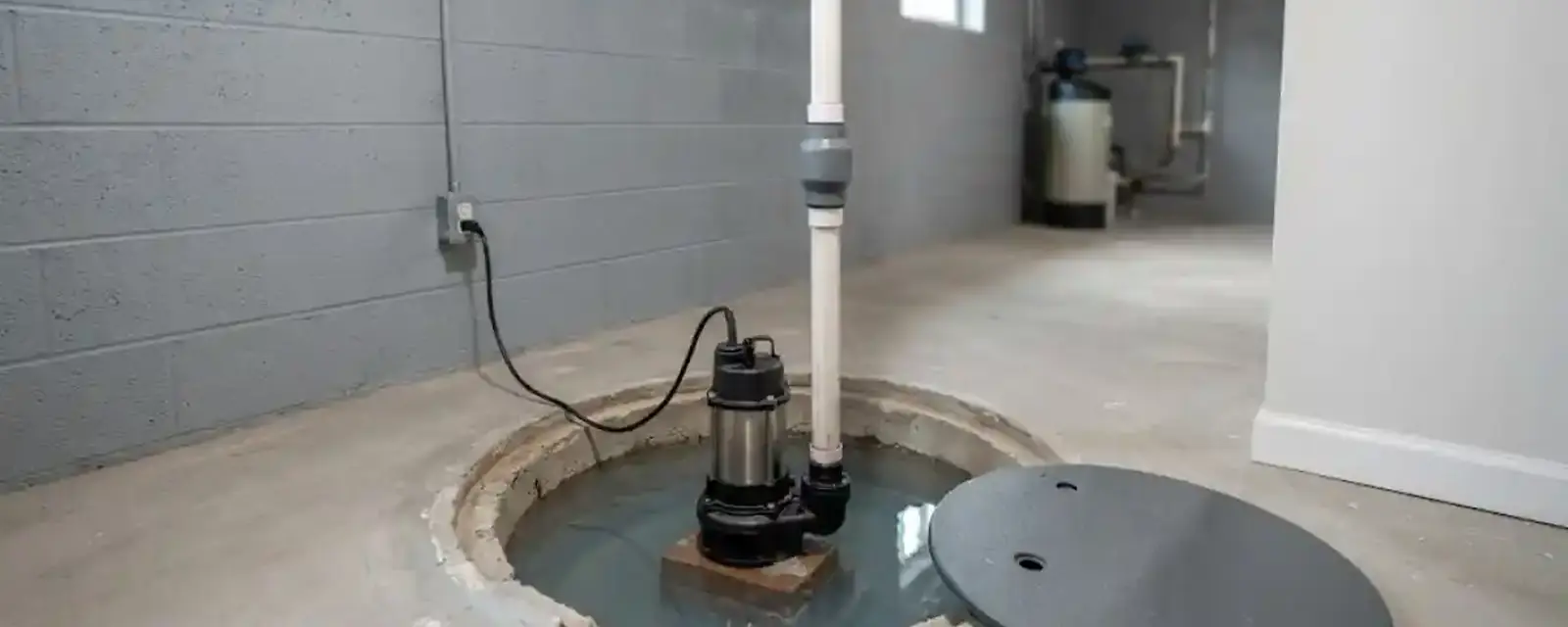
A sump pump sits in a pit at the lowest point of a basement and pushes groundwater out and away before it reaches the floor. In Reynoldsburg, OH, a pump that fails during a storm can leave inches of water in a finished basement within hours.
Sump pump repair means finding why the pump will not start, will not stop or will not move water, and then fixing or replacing the part that failed. If the basement is flooding now, call our 24/7 dispatch and stay out of standing water near electrical outlets.
Pump hums, runs nonstop or does nothing
Homeowners describe three main failures. Each points to a different part.
Hums but no pumping
The motor has power but the impeller is jammed with grit, or the check valve is stuck closed and the pump cannot push.
Runs without stopping
A stuck float, a failed switch or a pit that keeps refilling with groundwater keeps the pump on far past normal.
Never turns on
A tripped breaker, an unplugged cord, a dead switch or a burned motor all look identical from the stairs.
Cycles every few seconds
Water falling back down the discharge pipe because of a failed check valve makes the pump restart again and again.
Loud grinding or rattling
Worn bearings or a stone in the housing make noise long before the pump quits.
When basement water is rising
If water is climbing and the pump is silent, act on the electrical risk first. Standing water with a plugged-in pump is a shock hazard. Our 24/7 emergency dispatch can come at night or during a storm, and same-day appointments are available when the water is already controlled.
- Do not step into water if outlets or cords are wet
- Shut off the breaker for the area from a dry spot
- Move stored items up off the floor
- Check that the pump cord is plugged into a working outlet
- Check the float for something blocking its travel
- Do not run a vacuum or space heater near the water
How a sump repair visit goes
We test before we replace anything, since many failures come down to a small part.
Test the float
We lift the float by hand and see whether the pump starts and stops as it should.
Check the pit
Silt, gravel and debris in the bottom of the pit jam floats and burn out motors.
Inspect the check valve
A worn valve lets water fall back, so the pump cycles and wears out early.
Trace the discharge
Frozen, kinked or clogged outlet pipe keeps the pump from emptying the pit.
Repair or replace
A new switch or valve fixes some cases. A seized or burned motor means a new pump.
Pump quit during a storm?
Tell us what you hear from the pit and we can start sorting the cause on the phone.
Repair the pump or swap it out
A pump that is older than the roof over it deserves a cold look, since a failure during a storm costs more than a planned replacement.
Repair makes sense when
- The pump is fairly new and only the float failed
- The check valve is the only worn part
- The motor runs smooth and quiet
- Pit and discharge are clean and clear
Replace makes sense when
- The motor is seized, burned or very loud
- The pump has cycled constantly for years
- The housing is cracked or rusted through
- You want a battery backup added on
Sewage ejector pumps are a different machine
An ejector pump handles toilet and drain water from a basement bathroom that sits below the sewer line. It is a sealed pit with a gasketed lid and a vent, built to pass solids. A clear water sump pump cannot do that job, and the two should never be swapped.
Signs of a failing ejector include slow drains in the basement bathroom, gurgling and a sewer smell near the pit. Because the water is contaminated, we replace the pump and check the vent and gasket. For a recurring backup on the main line, see sewer line cleaning as well.
Quick symptom guide
This table sorts the usual signs by likely cause and next step.
| What you notice | Likely cause | What we do |
|---|---|---|
| Pump runs, water level does not drop | Stuck check valve or blocked discharge | Clear or replace the valve and test the outlet |
| Pump starts, then trips the breaker | Burned motor or wiring fault | Test the circuit, replace the pump if it fails |
| Pump never shuts off | Float stuck or switch failed | Free the float or replace the switch |
| Pit overflows in storms | Pump too small or one pump only | Review sizing and backup power options |
| Pump works but smells | Stagnant water or ejector vent issue | Clean the pit and check the vent |
A table cannot diagnose a pump. We still test it on site.
The pump only works if the water has somewhere to go
Discharge piping is the overlooked half of this system. The outlet has to carry water far enough from the foundation that it does not soak back into the same ground. A line that dumps beside the wall just recirculates the water and keeps the pump running.
If a trench or drain is needed to move water further, that work crosses into drainage, which we cover on our basement waterproofing page. We say plainly where plumbing stops and excavation or foundation work starts.
Before you call for pump repair
These steps cost nothing and tell us a lot.
- Check the breaker and the cord outlet for power
- Pour a bucket of water into the pit and watch
- Look for debris around the float arm
- Listen for humming, grinding or silence
- Check the outdoor discharge for flow or ice
- Note the age and brand label on the pump
What shapes a sump pump repair price
A float swap and a full pump install are different jobs, so the number moves with the scope.
Part versus whole pump
A switch or check valve is a small repair. A new pump and pit work is bigger.Pump type and horsepower
Submersible and pedestal pumps differ, and a stronger pump costs more to buy and wire.Pit condition
A pit full of silt or a cracked liner adds cleanup and sometimes a new basin.Discharge changes
Rerouting an outlet, adding a check valve or extending the line adds materials and time.Battery backup
A backup unit protects the basement during power loss and adds a second pump and a battery system.Water backup and sump failure coverage is often an optional endorsement and not part of a standard policy. Ask your insurer what yours includes before the next storm.
We give you a clear price before work starts. Want your real number? Call (614) 656-1470.
Blacklick Creek and Reynoldsburg basements
Blacklick Creek flows through Reynoldsburg, and homes near low ground or the creek often sit above a higher water table after long rain. A pump that is fine in dry months can run constantly in spring. Test it before the wet season so you are not learning about it from a wet carpet.
On where sump discharge may legally go, we do not guess. Ask your city or Columbus, which lists Reynoldsburg as a water and sewer contract community, before connecting any pump outlet to a sewer line. For installation questions, ask Franklin County Public Health whether work needs inspection.
Questions about sump pump repair
Yes. Dispatch is 24/7, which matters because most pumps fail during the storm that needs them. Tell us whether the pit is full, whether the pump hums or sits silent, and whether any outlets are wet, so we can plan the visit and tell you what is safe to do first.
A stuck float, a failed switch, a leaking check valve or a high water table can keep it going. If the pit refills within seconds after the pump stops, water is draining back down the pipe or flowing in faster than normal. We test the float first, then the valve.
There is no fixed number, since it depends on how often it runs and what is in the pit. A pump that cycles hard every wet season wears faster than one that runs a few times a year. Age, noise and a rusty housing are signs it is due.
It is a sealed pit that holds sewage and gas, and the lid, vent and union need to be reconnected correctly. We would not recommend it as a home project. A bad seal lets sewer gas into the house.
Drain lines that tie into a pit are plumbing work. Foundation crack repair and exterior membrane work are not. See what we do and do not handle for the exact split.
If your basement is finished or your pump runs hard in storms, a backup covers the case where the power goes out with the weather. It is a second pump and a battery, so it adds a part that needs periodic testing.
Also serving nearby towns
Dispatch for this service runs from Reynoldsburg to the towns below.