
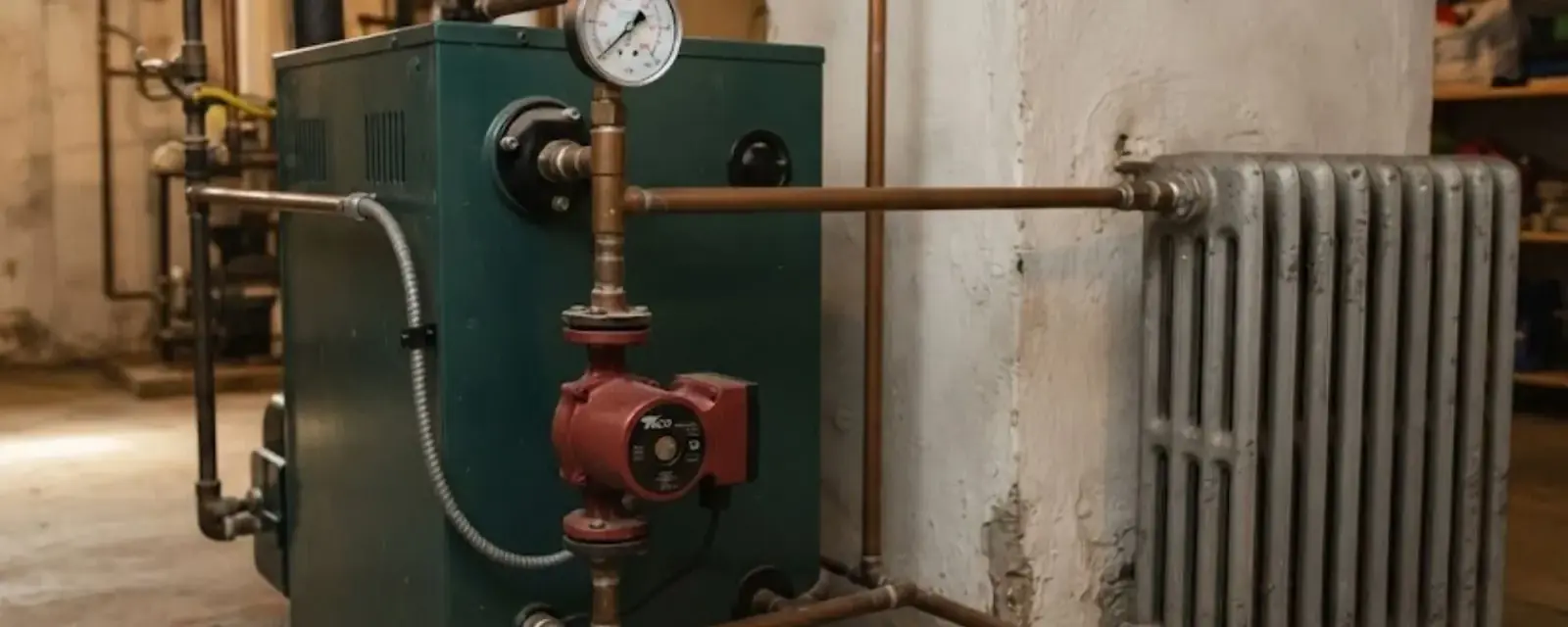
A boiler heats water, then sends that hot water or steam through radiators, baseboard, or floor loops. Reynoldsburg, OH homes with older radiators or hydronic floor heat may use one, and it is a different animal from a forced-air furnace. It holds pressure, burns fuel, and needs trained hands.
This guide covers warning signs, what a safe visit looks like, what drives the scope of a replacement, and the rule that matters most: if you smell gas, leave the building first and make the call from outside.
If you smell gas, leave first
The rotten egg odor added to natural gas means gas is escaping. Do not look for the source. Do not flip switches, use a phone inside, light a match, or start a car in an attached garage.
Get everyone out, including pets, then call your gas utility or 911 from outside or from a neighbor's home. Call us only after the utility says it is safe to go back in.
- Walk out and leave doors open as you go
- Stay upwind and away from the house
- Call your gas utility or 911 from outside
- Do not re-enter until the utility clears it
- Never try to relight a pilot after a gas smell
Signs your boiler needs attention
These symptoms are worth a service call. Some are urgent, some can wait for the next open appointment.
No heat or weak heat
Radiators stay cold or lukewarm even though the thermostat is calling. Air in the loop, a failed pump, or a tripped control may be behind it.
Banging or kettling noises
A rumble like a kettle often means scale or sludge on the heat exchanger. It gets worse over time.
Pressure gauge drifts
Pressure that climbs high or sinks low points to an expansion tank problem or a slow leak.
Puddles near the unit
Water around the base can come from a relief valve, a fitting, or a failing tank. Shut it off and call.
Yellow or sooty flame
A healthy burner flame is mostly blue. Yellow or soot can mean poor combustion, which is a safety issue.
Frequent restarts
A boiler that cycles on and off often may be oversized, have a failing sensor, or have a flow problem.
What you can safely do, and what you cannot
You can check the thermostat, bleed a radiator valve to release trapped air, look at the pressure gauge, and make sure nothing is stored against the boiler. You can also write down the make, model, and any error code on the display.
Do not open the burner compartment, adjust gas valves, replace safety controls, or remove a relief valve. These are not homeowner repairs. Gas and pressurized hot water can injure or kill, and work on either should be done only by a licensed professional.
Repair or replace: how to think about it
The right answer depends on age, condition, and how the heat is delivered. A technician can look at all three.
| Situation | Usually leans toward | Why |
|---|---|---|
| Single failed part, unit otherwise sound | Repair | A pump or sensor swap is a contained job |
| Cracked heat exchanger | Replace | Combustion safety and efficiency are affected |
| Repeated repairs in a short span | Replace | Parts keep failing as the unit ages |
| Old steam system, radiators working | Repair or service | The distribution system may outlast the boiler |
| Remodel or added zones | Replace with sizing review | Load changes how big the boiler should be |
Sizing is a calculation of heat loss, not a guess based on the old unit's nameplate.
How a boiler installation proceeds
A good replacement is planned, not rushed. Expect these stages.
Heat loss review
The plumber measures the house, counts radiators or floor loops, and sizes the boiler to the real load.
Fuel and venting plan
Gas line capacity, flue route, and combustion air are checked before anything is ordered.
Removal and set
The old unit is drained, disconnected, and removed. The new boiler is set, leveled, and piped.
Pressure and leak test
Water side joints are checked under pressure, and the gas connection is tested by a qualified technician.
Start-up and walkthrough
Controls are set, air is purged, and you get a plain explanation of the gauge, shutoff, and service routine.
How a replacement is priced without numbers
The scope drives the bill: boiler type, size, venting changes, new piping, circulator pumps, zone valves, and old equipment removal. A like-for-like swap with the same venting costs less labor than a conversion that reroutes the flue or adds zones.
That is why we give a clear price before work starts, after we have looked at the system. Our boiler repair visits come first when the problem is a failing part, and our installation crews handle new piping and equipment when a replacement is the better path.
Questions to ask any boiler contractor
Use these to compare quotes and to spot shortcuts.
- Are you licensed, and can I verify it online?
- How did you size the boiler for my house?
- What changes to venting and gas piping are needed?
- Which parts of the old system are being reused?
- What does the start-up and testing include?
- Who do I call after hours if it stops?
Serving neighbors around Reynoldsburg
Older homes in Gahanna and Pickerington often have heating systems that were added in stages, so a heat loss review matters more than the label on the old boiler. We dispatch to Gahanna and to Pickerington from Reynoldsburg, and 24/7 emergency dispatch applies to a boiler that is leaking or has failed on a cold night.
Reynoldsburg note: licensing for hydronics
Ohio Revised Code 4740.02 creates the Ohio Construction Industry Licensing Board within the Department of Commerce. Its plumbing and hydronics section has primary responsibility for licensing plumbing contractors, and section 4740.13 forbids acting as a licensed type of contractor without a license. Hydronic boilers fall under that framework.
The practical step: before you hire anyone, check the license through Ohio's online license lookup. Ask whether the person doing the work holds the license, and confirm before signing. For permit questions on your address, ask Franklin County Public Health or your plumber.
Source type: Ohio Revised Code 4740 (codes.ohio.gov) and Ohio Department of Commerce licensing lookup.
Quick answers
Leave the building right away, take everyone with you, and call your gas utility or 911 from outside. Do not switch lights on or off, use the phone inside, or try to find the leak. Call a plumber only after the utility says the home is safe.
Homeowners can bleed radiators and check the thermostat and gauge. Anything involving the burner, gas valve, relief valve, or controls should be handled by a licensed professional. Mistakes can cause fire, scalding, or carbon monoxide exposure.
Trapped air is the usual cause. Bleeding the radiator valve with a small key lets the air escape until water spurts out. If several radiators stay cold, the circulator pump or an air problem in the loop may need a plumber.
Short cycling, where the boiler fires and shuts down every few minutes, is a common sign. A proper heat loss calculation matches boiler output to the house, which also saves wear and fuel.
Ohio licenses plumbing contractors through the Ohio Construction Industry Licensing Board, and you can check a license through Ohio's online license lookup. Ask the contractor for the name on the license and compare before work starts.